
- [email protected]
- Anamnagar Kathmandu

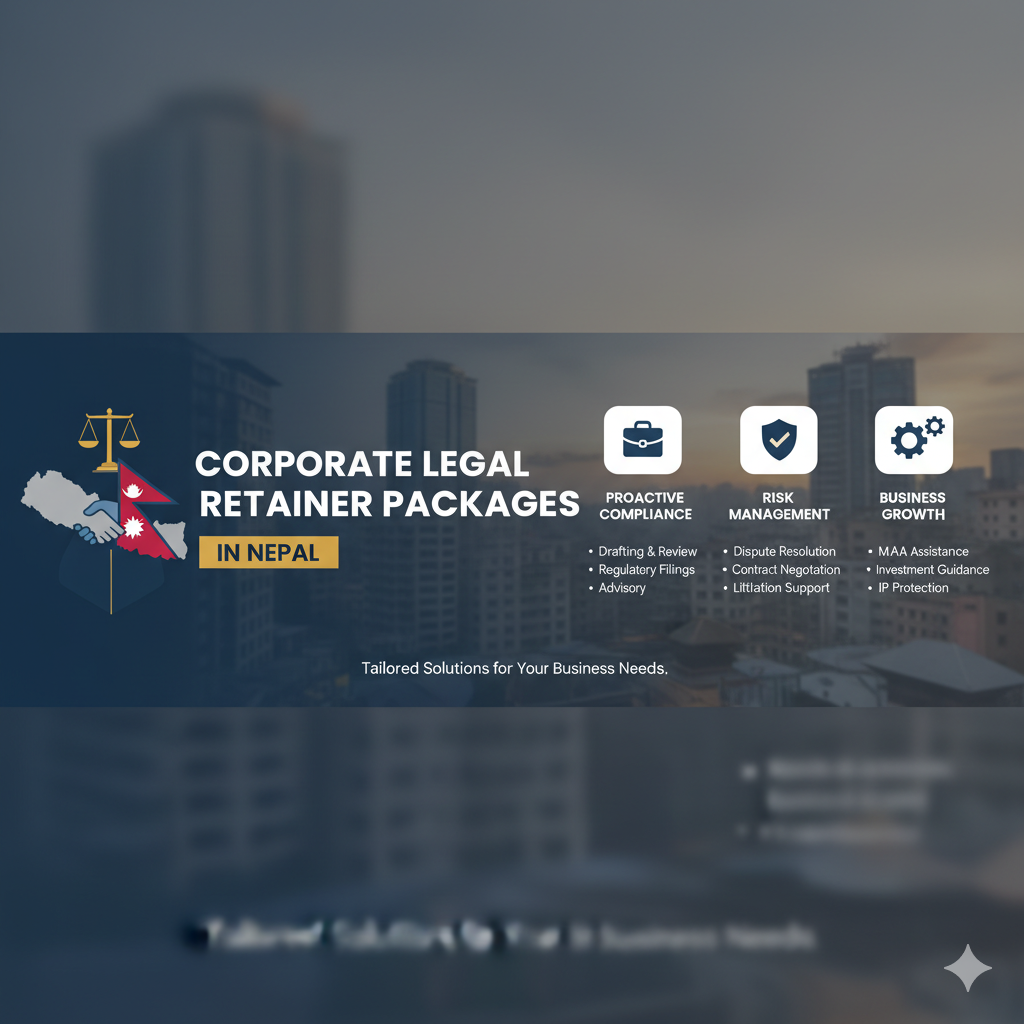
Corporate Legal Retainer Packages in Nepal
14
Nov
📊 Overview of Corporate Legal Retainership in Nepal
Corporate legal retainer packages in Nepal provide businesses with ongoing access to legal services for a fixed periodic fee. This arrangement has gained significant traction among corporations, small businesses, and enterprises seeking consistent legal counsel without the hassle of engaging lawyers on a case-by-case basis. The Nepal Bar Council and the Nepal Law Society regulate these services, ensuring professional standards and ethical compliance. Legal retainership typically covers a range of services including corporate compliance, contract management, labor disputes, intellectual property matters, and regulatory representation. By securing a retainer agreement, businesses ensure prompt legal assistance whenever needed, fostering proactive legal risk management rather than reactive problem-solving. The retainer model is particularly valuable in Nepal's evolving regulatory environment where businesses face increasing compliance requirements across various sectors including taxation, labor laws, and industry-specific regulations.
📋 Types of Legal Retainer Agreements in Nepal
General Retainer Agreement
A general retainer involves paying a fixed fee to secure a lawyer's availability over a specified period. Under this arrangement, the attorney remains accessible to provide legal advice and services as needed by the client. This type of retainer is ideal for businesses requiring ongoing legal support for routine matters such as compliance checks, document reviews, and general legal consultations. The fee ensures the lawyer prioritizes the client's needs and remains available for prompt assistance. General retainers are commonly used by businesses that face frequent but predictable legal needs and want the assurance of having legal counsel readily accessible without negotiating fees for each interaction.
Special Retainer Agreement
Also known as a flat fee retainer, this arrangement covers specific legal services or cases for a predetermined amount. The fee is typically fixed and agreed upon in advance based on the scope of work. This type of retainer is suitable for businesses with clearly defined legal projects such as company incorporation, trademark registration, or contract drafting. Special retainers provide cost certainty for particular legal matters and help businesses budget effectively for legal expenses. The scope of services is explicitly documented in the agreement, preventing misunderstandings about what is included in the retainer fee.
Retaining Fee (Security Retainer)
A retaining fee functions as an advance payment made when hiring a lawyer. These funds are held in a trust account and deducted as the lawyer performs services. This arrangement differs from other retainers as it essentially functions as a deposit against future billing rather than a payment for availability. The client receives detailed statements showing how the funds are utilized, and additional payments may be required if the initial deposit is exhausted. This model provides flexibility while ensuring the lawyer has secured funds for their services.
💰 Corporate Legal Retainer Fee Structures in Nepal
Hourly Rate Retainers
Some law firms in Nepal offer retainer packages based on hourly rates with discounted rates for retainer clients. Under this model, clients pay a monthly fee that purchases a certain number of attorney hours at a preferential rate compared to non-retainer clients. Any unused hours typically roll over to the next month or are forfeited depending on the agreement terms. This structure works well for businesses with fluctuating legal needs that cannot be precisely predicted in advance. The discounted hourly rates provide cost savings while ensuring priority service when needed.
Flat Fee Monthly/Quarterly Retainers
Fixed fee retainers involve paying a set amount monthly or quarterly for a predefined package of services. This model offers predictability in budgeting and is ideal for businesses with regular legal needs. The scope of services is clearly defined in the agreement, typically including routine legal consultations, document reviews, compliance checks, and standard contract drafting. Any services beyond the agreed scope are billed separately, usually at preferential rates. This structure is popular among small and medium-sized enterprises that require ongoing legal support but have limited budgets.
Percentage-Based Retainers
For certain corporate legal matters, some law firms in Nepal offer percentage-based retainers where the fee is calculated as a percentage of the client's revenue or transaction value. This model aligns the law firm's compensation with the client's business performance and is sometimes used for ongoing commercial litigation or merger and acquisition support. This structure is less common for routine corporate retainers but may be negotiated for specific long-term projects or for startups with limited cash flow but high growth potential.
📈 Factors Influencing Corporate Legal Retainer Costs in Nepal
Scope and Complexity of Services
The breadth and depth of legal services required significantly impact retainer fees. Packages covering comprehensive legal support including litigation, regulatory compliance, intellectual property management, and contract negotiations naturally command higher fees than basic packages focusing only on routine legal consultations and document reviews. The complexity of the client's business operations and industry-specific regulatory requirements also play a crucial role in determining fees. Businesses in highly regulated sectors such as banking, telecommunications, or pharmaceuticals typically face higher retainer costs due to the specialized knowledge required.
Law Firm Reputation and Attorney Experience
Prestigious law firms with established track records in Nepal's corporate legal market generally charge higher retainer fees compared to smaller or newer firms. Similarly, the experience level of assigned attorneys influences costs - packages involving senior advocates or partners with decades of experience cost more than those with junior attorneys. However, higher fees often correlate with deeper expertise, broader networks, and more efficient problem-solving capabilities. Firms with specialized knowledge in emerging areas such as technology law, international arbitration, or cross-border transactions may also command premium rates.
Client Size and Industry
The scale of operations and industry sector significantly affect retainer pricing. Large corporations with complex legal needs naturally pay more than small businesses or startups. Industries with higher regulatory scrutiny or greater litigation risks face higher fees. For instance, manufacturing companies may need extensive environmental law compliance support, while IT companies might focus on intellectual property protection. Some law firms offer tiered pricing based on employee count, annual revenue, or transaction volume, allowing businesses to select packages appropriate to their scale.
Geographic Location and Service Delivery Model
While Kathmandu-based law firms typically charge higher fees due to higher operational costs and concentration of legal expertise, firms in other major cities like Pokhara or Biratnagar may offer more competitive rates. The service delivery model also impacts costs - packages including on-site attorney visits, 24/7 availability, or international travel components cost more than purely remote or office-based services. Firms investing in advanced legal technology platforms may charge higher fees but offer greater efficiency and transparency through client portals and automated reporting systems.
📊 Corporate Legal Retainer Package Tiers and Pricing in Nepal
Table: Typical Corporate Legal Retainer Packages and Pricing in Nepal (2026 Estimates)
| Package Tier | Monthly Fee Range (NPR) | Key Services Included | Best For |
|---|---|---|---|
| Basic | 50,000 - 100,000 | Legal consultations, document reviews, basic compliance, standard contracts | Small businesses, startups |
| Standard | 100,000 - 250,000 | All basic services + litigation support, specialized contracts, regulatory filings | Medium enterprises, growing companies |
| Premium | 250,000 - 500,000+ | All standard services + strategic advice, international transactions, dedicated team | Large corporations, multinational operations |
Basic Retainer Package
The basic package typically suits small businesses and startups with fundamental legal needs. Services usually include unlimited legal consultations via phone or email, review of up to five standard contracts per month, basic compliance checks, and assistance with routine registrations. Response times may be longer compared to premium packages, and specialized legal matters often incur additional charges. This entry-level option provides cost-effective access to legal support for businesses with predictable and straightforward requirements.
Standard Retainer Package
The standard package caters to medium-sized enterprises with more complex legal needs. In addition to all basic services, it typically includes litigation support, specialized contract drafting, regulatory filings, intellectual property basics, and employment law guidance. Clients receive faster response times and may have access to more experienced attorneys. This package balances comprehensiveness with cost-effectiveness for growing businesses facing increasing legal complexities as they expand their operations.
Premium Retainer Package
The premium package serves large corporations and multinational companies with sophisticated legal requirements. It encompasses all standard services plus strategic legal advice, international transaction support, dedicated attorney teams, on-site visits, and 24/7 availability for urgent matters. Clients receive priority service and comprehensive legal management across all business functions. This all-inclusive option provides complete legal peace of mind for organizations with high stakes and complex regulatory environments.
📝 Essential Components of Legal Retainer Agreements in Nepal
Scope of Services
The service scope document clearly outlines what legal services are included in the retainer fee and what constitutes additional billable work. It specifies the number of attorney hours available, types of documents covered, response time commitments, and limitations on the agreement. Precise definition of scope prevents misunderstandings and disputes over billing. The agreement should detail whether services such as court appearances, extensive negotiations, or specialized research are included or require separate billing. Clear parameters ensure both parties have aligned expectations regarding deliverables.
Fee Structure and Payment Terms
The payment terms section specifies the retainer amount, payment schedule (monthly, quarterly, or annually), and accepted payment methods. It should outline any additional charges for services beyond the scope and how these are calculated. The agreement must clarify whether unused portions of the retainer are forfeited, rolled over, or refunded. VAT and other applicable taxes should be explicitly addressed to avoid confusion. Late payment penalties and interest charges for overdue amounts should also be clearly stipulated.
Duration and Termination Clauses
Retainer agreements in Nepal typically range from six months to three years, with common durations being 1-2 years. The agreement should specify the exact term, conditions for renewal, and notice periods required for termination by either party. It should outline the handling of unfinished work and final billing upon termination. Provisions for early termination, including any penalties or notice requirements, must be clearly stated. The agreement should also address circumstances under which either party can terminate the arrangement immediately for cause.
Confidentiality and Conflict of Interest
Confidentiality provisions ensure that all client information remains protected even after the agreement ends. The agreement should include clauses preventing the attorney from representing competing interests without consent. A comprehensive conflict of interest check must be completed before signing the agreement. The document should also specify procedures for handling potential conflicts that may arise during the engagement. These provisions protect client interests and maintain professional ethics standards.
Establish Communication Protocols
Step 1: Assess Legal Needs
The process begins with a thorough assessment of your legal requirements across all business functions. Identify routine legal tasks, potential risk areas, compliance obligations, and anticipated legal challenges. Consider both immediate needs and future requirements as your business grows. This assessment helps determine the appropriate package tier and scope of services needed. Document specific priorities such as contract management, employment law compliance, intellectual property protection, or regulatory filings to guide discussions with potential service providers.
Step 2: Research Potential Providers
Identify law firms specializing in corporate law with experience in your industry. Seek recommendations from business associates, professional networks, and industry associations. Research potential providers' websites, review their client testimonials, and check their standing with the Nepal Bar Council. Look for firms with demonstrated expertise in areas relevant to your business needs. Create a shortlist of 3-5 potential providers for further evaluation based on their capabilities, reputation, and compatibility with your business culture.
Step 3: Initial Consultation
Schedule consultation meetings with shortlisted firms to discuss your legal needs in detail. Use these meetings to assess their understanding of your industry, proposed approach to your requirements, and compatibility with your team. Ask about their experience with similar businesses and request case studies or references. Evaluate their responsiveness, communication style, and willingness to customize solutions rather than offering one-size-fits-all packages.
Step 4: Request Detailed Proposals
Ask each shortlisted firm to provide a comprehensive proposal outlining their recommended retainer package. The proposal should detail the scope of services, fee structure, attorney credentials, communication protocols, and performance metrics. Request information on their billing practices, availability policies, and procedures for handling urgent matters. Ask for references from current corporate clients to validate their claims about service quality and responsiveness.
Step 5: Evaluate and Compare
Compare proposals based on both quantitative factors (cost, included services) and qualitative factors (expertise, cultural fit, responsiveness). Create a comparison matrix to evaluate each provider against your specific priorities. Consider the long-term value rather than just the immediate cost implications. Look for providers who demonstrate a clear understanding of your business and offer proactive solutions rather than merely reactive legal support.
Step 6: Negotiate Terms
Once you've selected a preferred provider, negotiate the final terms of the retainer agreement. Discuss any necessary adjustments to the scope of services, fee structure, or performance expectations. Clarify ambiguous points and ensure all verbal commitments are documented in writing. Pay special attention to clauses regarding termination, fee increases, and additional charges. Consider a trial period or initial shorter term to evaluate the relationship before committing to a longer engagement.
Step 7: Due Diligence and Agreement Execution
Before signing, conduct final due diligence on the law firm and assigned attorneys. Verify their credentials with the Nepal Bar Council and check for any disciplinary history. Ensure all necessary documents are in order, including the retainer agreement, conflict of interest disclosure, and fee schedule. Once satisfied, execute the agreement and arrange for the initial payment as per the agreed terms. Establish clear communication protocols and reporting mechanisms from the outset.
📜 Essential Documents for Legal Retainer Service Agreements
Core Agreement Documents
The retainer agreement contract forms the foundation of the relationship and must be comprehensive and precise. It should include a detailed scope of work document outlining all included services and limitations. A clear fee structure and payment terms document prevents misunderstandings about billing. The service level agreement (SLA) specifies performance metrics, response times, and quality standards. All these documents must be carefully reviewed and understood before signing to ensure they accurately reflect the agreed terms.
Regulatory and Compliance Documents
Nepal Bar Council registration certificates of the assigned attorneys verify their professional standing. The law firm's professional indemnity insurance certificate provides protection against malpractice. For corporate clients, proper identification documents including company registration certificates and lists of authorized representatives are essential. If applicable, a power of attorney document should be executed to authorize the attorneys to act on the company's behalf. All documents must comply with the requirements of the Nepal Contract Act, 2056 (2000).
Confidentiality and Disclosure Documents
A comprehensive confidentiality agreement protects sensitive business information shared during the engagement. The conflict of interest disclosure document ensures no ethical violations in representing your interests. For certain industries, additional regulatory compliance documents may be required. All parties should retain copies of all executed documents for reference throughout the engagement period. These documents provide legal protection and establish clear expectations for both parties.
💼 Benefits of Corporate Legal Retainership for Businesses
Proactive Legal Risk Management
Retainer arrangements enable preventive legal care rather than reactive problem-solving. Regular legal reviews identify potential issues before they escalate into costly disputes. Ongoing legal support ensures compliance with evolving regulations across multiple jurisdictions. This proactive approach significantly reduces legal risks and associated costs over time. Businesses with retainers typically avoid many common legal pitfalls through continuous monitoring and guidance from attorneys familiar with their operations.
Cost Predictability and Budget Efficiency
Retainer agreements provide predictable legal expenses that facilitate accurate budgeting and financial planning. Fixed monthly or quarterly fees eliminate the uncertainty of ad-hoc legal billing. Retainer clients typically receive preferential rates compared to one-time engagements, providing cost savings over time. The ability to forecast legal expenses accurately is particularly valuable for businesses with tight budget controls or those operating in competitive markets with thin margins.
Enhanced Business Decision Making
Having ongoing access to legal counsel improves the quality of business decisions by identifying legal implications early in the process. Attainers familiar with your business can provide more relevant and contextual advice than unfamiliar lawyers. This integrated legal support enables faster decision-making without compromising legal compliance. Businesses with retainers can confidently pursue opportunities knowing they have immediate access to legal guidance when needed.
Priority Service and Relationship Benefits
Retainer clients typically receive priority response and faster turnaround times compared to one-time clients. The ongoing relationship allows attorneys to develop deeper understanding of your business operations, culture, and objectives. This familiarity leads to more practical and effective legal solutions tailored to your specific context. Long-term relationships also foster better communication and collaboration between legal teams and business units.
⚖️ Considerations Before Signing a Corporate Legal Retainer
Assessing Actual Legal Needs
Before committing to a retainer, objectively evaluate your actual legal requirements based on historical patterns and future plans. Review past legal expenses and frequency of legal engagements to determine if a retainer makes financial sense. Consider both routine legal needs and potential future requirements as your business grows. Avoid overestimating needs to justify higher-tier packages, but also ensure adequate coverage for essential legal support.
Comparing Retainer vs. Ad-Hoc Costs
Calculate the break-even point where retainer costs become more economical than hourly billing. Consider the value of priority access and preventive legal care beyond pure cost calculations. Factor in the administrative efficiency of having a dedicated legal team rather than sourcing lawyers for each matter. For businesses with very sporadic legal needs, ad-hoc arrangements might be more cost-effective than retainers.
Evaluating Law Firm Compatibility
Beyond legal expertise, assess the cultural fit and communication style of potential law firms. Consider their approach to client service and willingness to understand your business context. Evaluate the technology platforms they offer for case management and communication. Ensure the assigned attorneys have the right balance of expertise and availability for your needs. A good fit between your business and the law firm enhances the effectiveness of the retainer relationship.
Understanding Exit Strategies
Before signing, understand the termination provisions and exit procedures clearly. Know the notice periods required and any penalties for early termination. Clarify how ongoing matters will be handled during the transition period. Ensure all your documents and files will be returned promptly upon termination. A clear understanding of exit strategies prevents complications if you need to change legal providers in the future.
🔮 Future Trends in Corporate Legal Retainership (2026 Projections)
Technology-Enabled Service Delivery
Legal technology adoption is transforming retainer services in Nepal, with firms increasingly offering client portals, automated document management, and AI-powered contract analysis. These technological advancements enhance efficiency and transparency while reducing costs. Virtual legal services are becoming more sophisticated, enabling remote collaboration without compromising service quality. Firms investing in legal tech are likely to offer more competitive retainer packages with enhanced service delivery capabilities.
Specialized Industry-Specific Packages
Law firms are developing industry-focused retainer packages tailored to specific sectors such as technology, healthcare, manufacturing, and financial services. These specialized packages address the unique regulatory and compliance requirements of each industry. As Nepal's economy diversifies, demand for sector-specific legal expertise will continue to grow. Businesses increasingly prefer attorneys with deep knowledge of their industry rather than general practitioners.
Flexible Pricing Models
Beyond traditional flat fees, innovative pricing structures are emerging, including subscription-based models, value-based billing, and success fees tied to specific outcomes. These flexible arrangements align law firm compensation with client business objectives. Some firms offer tiered packages with scalable options that grow with the client's business. These alternative pricing models provide greater choice and customization options for businesses of all sizes.
Increased Focus on Preventive Compliance
With regulatory environments becoming more complex, preventive compliance services are becoming central to retainer packages rather than add-on services. Proactive compliance monitoring, regular audits, and employee training programs are increasingly included in standard packages. This shift reflects growing recognition that preventive legal care is more cost-effective than reactive dispute resolution. Businesses are prioritizing compliance investments to avoid costly penalties and reputational damage.
❓ Frequently Asked Questions
What is the average duration of corporate legal retainer agreements in Nepal?
Corporate legal retainer contracts in Nepal typically range from six months to three years, with most businesses opting for 1-2 year agreements. The duration depends on the client's needs and the complexity of legal services required. Some agreements include automatic renewal clauses unless either party provides notice of termination.
Are there additional government fees associated with legal retainer services?
While legal retainer services primarily involve private agreements, certain government fees may apply including contract registration fees, stamp duty as per the Stamp Duty Act, 2019, and 13% VAT on legal services as per the Value Added Tax Act, 2052 (1996). These additional costs should be factored into the overall budget for legal services.
Can I negotiate the scope of services in a retainer package?
Yes, the scope of services is negotiable and should be clearly documented in the retainer agreement. Most law firms are willing to customize packages based on the client's specific needs and budget. It's important to precisely define what is included and excluded to avoid misunderstandings about billing for additional services.
What happens if I use all the included services before the end of the retainer period?
Policies vary by law firm, but most offer options such as billing additional services at preferential rates, upgrading to a higher tier package, or prorating additional fees. These provisions should be clearly outlined in the retainer agreement to avoid surprises. Some firms include rollover hours for unused services, while others have use-it-or-lose-it policies.
How quickly can I expect a response from a retainer attorney?
Response times vary by package tier but typically range from same-day responses for premium clients to 24-48 hours for standard packages. Many retainer agreements specify guaranteed response times for different types of inquiries. Urgent matters usually receive immediate attention regardless of package tier, but this should be confirmed in the agreement.
Can I terminate a retainer agreement early if I'm not satisfied?
Most retainer agreements include termination provisions that allow either party to end the relationship with proper notice, typically 30-60 days. Early termination may involve financial penalties or payment for services already rendered. Some agreements include trial periods or satisfaction guarantees. These terms should be clearly understood before signing the agreement.
📚 Conclusion
Corporate legal retainer packages in Nepal offer businesses a strategic approach to managing legal needs through predictable costs and proactive support. The right retainer arrangement provides immediate access to legal expertise, enhances compliance, and supports better business decision-making. When selecting a package, carefully evaluate your actual legal needs, compare providers thoroughly, and negotiate terms that align with your business objectives. As Nepal's legal and regulatory landscape continues to evolve, having dedicated legal support through a well-structured retainer agreement becomes increasingly valuable for sustainable business growth. The investment in a quality retainer package typically pays dividends through risk reduction, operational efficiency, and enhanced legal protection for your business interests.