
- [email protected]
- Anamnagar Kathmandu

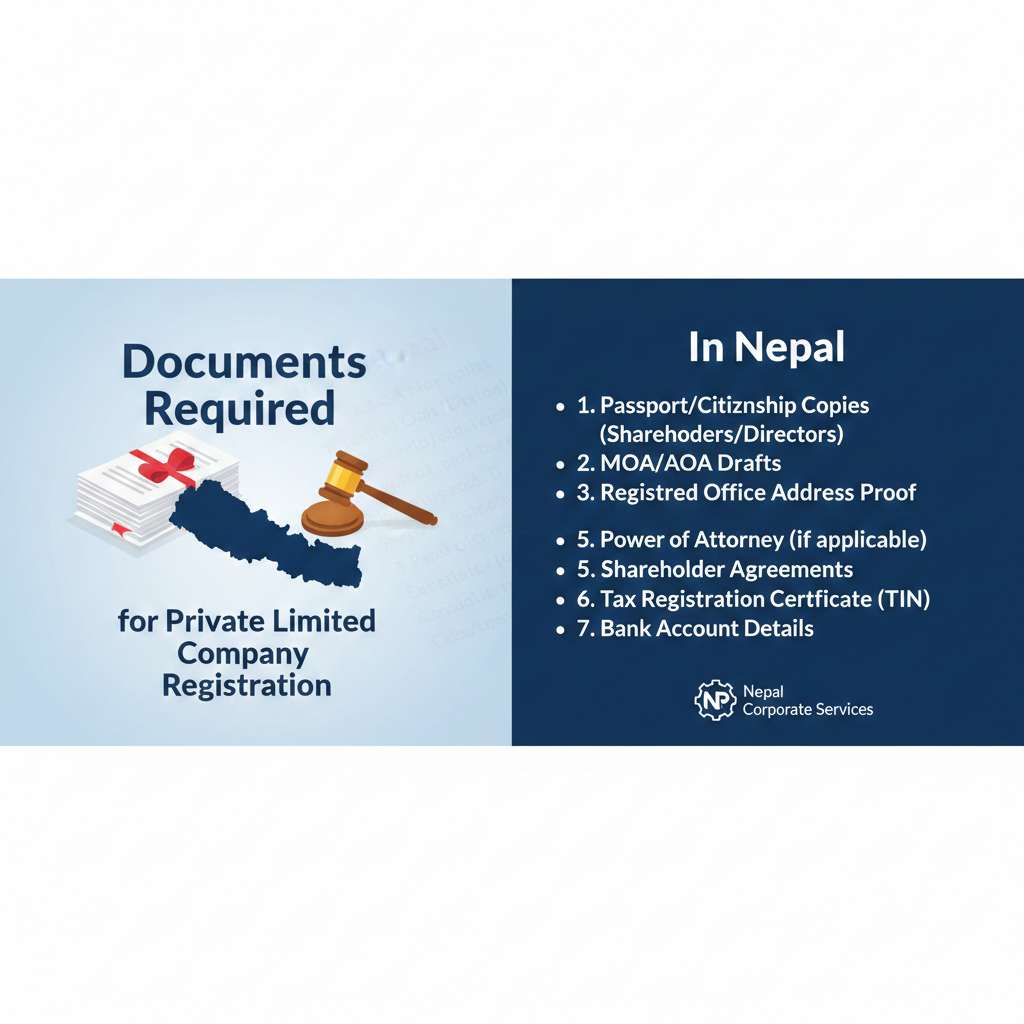
Documents Required for Private Limited Company Registration in Nepal
01
Dec
Documents Required for Private Limited Company Registration in Nepal: The Ultimate Checklist
Introduction Preparing the correct documents required for private limited company registration in Nepal is the most critical step to ensure a smooth and efficient incorporation process. The Office of the Company Registrar (OCR) mandates a specific set of legal papers to verify the identity of directors and shareholders and to establish the company's legal framework. Any discrepancy or missing document can lead to significant delays. This definitive guide provides a comprehensive, step-by-step checklist of all necessary documents, tailored for both Nepalese citizens and foreign investors, to help you navigate the process with confidence.
Why Proper Document Preparation is Crucial
The company registration process in Nepal is governed by the Companies Act, 2006 (2053 BS). This legal framework is designed to ensure transparency and legal compliance. Submitting a complete and accurate set of documents is not merely a procedural formality; it is the foundation of your company's legal identity. Proper preparation prevents rejection of your application, avoids unnecessary legal complications, and significantly speeds up the time it takes to receive your Certificate of Incorporation.
Comprehensive Checklist of Required Documents
The documents can be categorized into three main groups: those required from all individuals involved, those specific to the company itself, and additional requirements for foreign nationals.
Category 1: Documents from All Directors & Shareholders
These documents are mandatory for every individual, regardless of their nationality or shareholding percentage, who is proposed as a director or shareholder in the company.
- Recent Passport-Sized Photographs: 3-5 copies per individual.
- Personal Details Form: A duly completed form providing full name, father's name, grandfather's name, date of birth, permanent address, temporary address, contact number, and occupation.
- Specimen Signature: Copies of the signature of each director and shareholder.
Category 2: Documents for Nepalese Directors & Shareholders
In addition to the documents in Category 1, individuals holding Nepalese citizenship must provide the following:
- Citizenship Certificate: A self-attested copy of the Nepalese citizenship certificate.
- PAN (Permanent Account Number) Copy: If the individual already has a PAN, a copy must be provided. If not, it will be registered along with the company.
Category 3: Documents for Foreign Directors & Shareholders
Foreign nationals are subject to more stringent documentation requirements under Nepal's foreign investment policies.
- Passport Copy: A clear, notarized copy of the passport.
- Valid Visa Copy: A copy of the current Nepalese visa.
- Proof of Address: A utility bill or bank statement from their home country, notarized and translated if necessary.
- Curriculum Vitae (CV): A detailed CV for each foreign director.
- Source of Fund Statement: A declaration and bank statement showing the legal source of the investment funds.
- Recommendation Letter: A letter of recommendation from their home country's bank or a relevant institution.
- FITTA Approval: For companies with foreign investment, approval from the Department of Industry under the Foreign Investment and Technology Transfer Act (FITTA) is required before company registration.
Category 4: Company-Specific Documents
These documents pertain to the legal entity being created.
- Proposed Company Names: A list of 3-5 proposed company names, in order of preference.
- Memorandum of Association (MoA): This document defines the company's constitution, its objectives, scope of business, and relationship with the outside world. It must be drafted, signed by all subscribers, and notarized.
- Articles of Association (AoA): This document outlines the internal rules and regulations for managing the company's affairs, including the rights and duties of directors, shareholder meetings, and share transfers. It must also be drafted, signed, and notarized.
- Proof of Registered Office Address: This is a critical document. It can be either:
- A Rental Agreement: A notarized copy of the rental/lease agreement for the company's registered office, along with a consent letter from the landlord.
- An Ownership Certificate: A copy of the land ownership certificate (Lal Purja) if the office is in a self-owned property.
- Initial Capital Deposit Evidence: A bank voucher or statement showing the deposit of the initial paid-up capital into a temporary bank account opened in the company's name.
Master Document Checklist Table
For quick reference, use this table to ensure you have every document required for a smooth registration.
| Document Category | Required For | Nepalese National | Foreign National | Company Specific |
|---|---|---|---|---|
| Passport-sized Photos | All Directors/Shareholders | ✓ | ✓ | |
| Personal Details Form | All Directors/Shareholders | ✓ | ✓ | |
| Citizenship Certificate | Nepalese Directors/Shareholders | ✓ | ||
| Passport Copy | Foreign Directors/Shareholders | ✓ | ||
| Valid Visa Copy | Foreign Directors/Shareholders | ✓ | ||
| Proof of Address | Foreign Directors/Shareholders | ✓ | ||
| Source of Funds Statement | Foreign Shareholders | ✓ | ||
| Memorandum of Association (MoA) | The Company | ✓ | ||
| Articles of Association (AoA) | The Company | ✓ | ||
| Proof of Registered Office | The Company | ✓ | ||
| Initial Capital Deposit Proof | The Company | ✓ | ||
| Name Reservation Slip | The Company | ✓ |
The Role of Notarization and Translation
Many documents, especially the Memorandum and Articles of Association (MoA & AoA), rental agreements, and documents from foreign nationals, must be notarized by a registered notary public in Nepal. Notarization verifies the authenticity of the signatures and documents. Furthermore, any document not in English or Nepali must be translated by a certified translator and notarized. Failure to do so will result in the rejection of your application.
Document Submission Process Flow
Understanding where each document fits in the process is key.
- Name Reservation: Submit proposed names to the OCR. Once approved, you receive a name reservation slip.
- Document Preparation: Gather all personal documents from directors/shareholders. Draft the MoA and AoA. Secure the proof of registered office.
- Notarization & Translation: Get all necessary documents notarized and translated.
- Online Submission: Upload scanned copies of all documents to the OCR's online portal.
- Physical Submission: Submit the original, hard copies of the notarized documents to the OCR office.
- Review & Approval: The OCR reviews the submission. If everything is in order, the Certificate of Incorporation is issued.
Common Mistakes to Avoid with Your Documents
- Mismatched Information: Ensure names, spellings, and addresses are identical across all documents (e.g., citizenship, PAN, MoA/AoA).
- Expired Documents: Check the validity of passports and visas for foreign nationals.
- Missing Signatures: Every page of the MoA and AoA must be signed by all subscribers in the presence of witnesses.
- Unclear Scans: Ensure all scanned copies for online submission are high-quality and legible.
- Ignoring FITTA: For foreign investment, attempting to register without prior FITTA approval is a critical error.
Frequently Asked Questions (FAQ)
What is the difference between the Memorandum of Association (MoA) and Articles of Association (AoA)?
The Memorandum of Association (MoA) defines the company's external relationships and objectives (what the company will do). The Articles of Association (AoA) defines the company's internal management and rules (how the company will operate internally). Both are foundational legal documents required for registration.
Where do I get the Memorandum and Articles of Association drafted?
While templates are available, it is highly recommended to have the MoA and AoA drafted by a legal professional or a company registration expert in Nepal. This ensures they are compliant with the Companies Act, 2006, and tailored to your specific business needs, preventing future legal issues.
Can I use my residential address as the company's registered office?
Yes, you can use your residential address as the company's registered office, provided you have a valid proof of address (ownership certificate or a notarized rental agreement) and consent from the property owner.
Do I need to submit original documents or are photocopies sufficient?
For the initial online submission, high-quality scanned copies are required. However, after online approval, you must submit the original, self-attested, and notarized hard copies of documents like the MoA, AoA, and rental agreement to the Office of the Company Registrar.
What if a director is outside Nepal during the registration process?
If a director is outside Nepal, their documents (passport, photos, signature) must be sent to Nepal. The MoA and AoA can be signed abroad, but the signatures must be verified and notarized according to the laws of that country and then attested by the Nepalese embassy or consulate in that country.
Conclusion
Meticulously preparing the documents required for private limited company registration in Nepal is the cornerstone of a successful business launch. By following this comprehensive checklist and ensuring every document is accurate, complete, and properly notarized, you can avoid common pitfalls and accelerate your path to becoming a legally recognized entity. The process demands attention to detail, but the reward of establishing your company on a solid legal foundation is immeasurable.
For a seamless and error-free registration experience, especially when dealing with foreign investments or complex business structures, it is always advisable to seek guidance from experienced legal professionals in Nepal who specialize in company law.