
- [email protected]
- Anamnagar Kathmandu

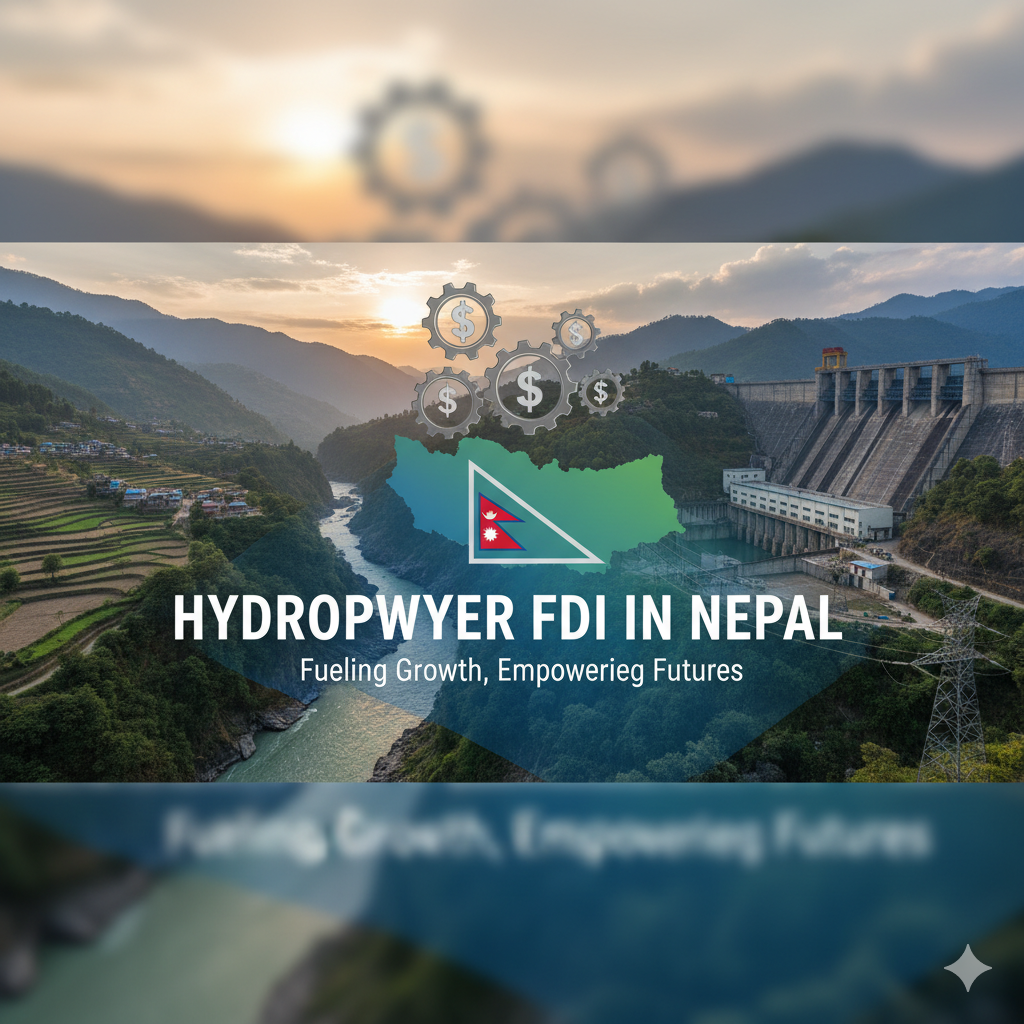
Hydropower FDI in Nepal
14
Nov
Hydropower FDI in Nepal: A 2026 Investor's Guide to 'White Gold'
📊 Introduction: The Potential of Hydropower FDI in Nepal
Hydropower FDI in Nepal represents one of the most significant investment opportunities in South Asia. Endowed with an estimated hydropower potential of over 83,000 MW, of which approximately 43,000 MW is technically and economically feasible, Nepal has aptly termed its water resources "white gold." The government has identified the energy sector as a cornerstone for national development and economic prosperity, creating a highly favorable environment for foreign investment. The Foreign Investment and Technology Transfer Act (FITTA), 2075 (2019), along with the Electricity Act, 2049 (1992), provides the legal framework for foreign investors to participate in this burgeoning sector. Investing in Nepalese hydropower offers access to a growing domestic market and, more importantly, the massive energy markets of neighboring India and Bangladesh. This guide provides a factual and detailed roadmap for foreign investors looking to capitalize on Nepal's hydropower potential.
🌟 Why Invest in Nepal's Hydropower Sector?
Nepal's hydropower sector is not just an energy play; it is a strategic long-term investment supported by geographical advantages, government commitment, and expanding market access. The convergence of these factors creates a compelling case for foreign direct investment, moving beyond potential to tangible, bankable projects.
Immense Untapped Potential
The sheer scale of Nepal's untapped hydropower resources is the primary attraction. With current installed capacity hovering around 2,500 MW against a potential of over 83,000 MW, the sector is in its nascent stages. The country's topography, featuring steep gradients and perennial rivers originating from the Himalayas, provides ideal conditions for constructing cost-effective run-of-the-river and storage-type hydroelectric projects. This vast, untapped potential ensures a long pipeline of investment opportunities for decades to come, from small-scale projects to large, multi-gigawatt complexes.
Favorable Government Policies and Incentives
The Nepalese government has actively courted foreign investment in hydropower by liberalizing policies and offering attractive incentives. FITTA allows for up to 100% foreign equity in hydropower projects. The government has also established the Investment Board Nepal (IBN) to act as a one-stop-shop for large-scale projects, streamlining the approval process. Additional incentives include income tax holidays for the initial years of operation, exemptions on customs duties for imported construction materials and machinery, and guarantees for the repatriation of profits and capital. These policies are designed to mitigate risk and enhance the financial viability of projects.
Growing Energy Market and Export Potential
While Nepal's domestic electricity demand is growing at over 10% annually, the real prize lies in energy export. Nepal has signed a Power Trade Agreement with India, allowing for the export of electricity to the world's fifth-largest electricity market. Similar agreements are being pursued with Bangladesh. This cross-border electricity trade transforms a domestic project into a regional export-oriented asset, providing a secure and lucrative revenue stream for investors. The ability to sell power to a large, creditworthy off-taker like India's power market fundamentally improves the bankability and attractiveness of Nepalese hydropower projects.
📜 The Legal Framework for Hydropower FDI
The legal environment for hydropower FDI in Nepal is structured to provide clarity, security, and a clear pathway for investors. It is built upon a foundation of acts and policies that collectively define the rules of engagement, from project approval to operation and profit repatriation.
Governing Laws and Regulations
The Foreign Investment and Technology Transfer Act (FITTA), 2075 is the principal law governing FDI, ensuring the right to repatriate profits and guarantees against nationalization. The Electricity Act, 2049 governs the development, generation, and distribution of electricity. It details the licensing process, including the issuance of Survey Licenses and Generation Licenses. The Water Resources Act, 2049 regulates the use of water resources. For large-scale projects exceeding a certain capacity (currently 500 MW, though this is subject to change), the Investment Board Nepal (IBN) Act, 2071 provides a high-level facilitation and approval mechanism, bypassing some of the standard bureaucratic layers.
Investment Thresholds and Ownership
Foreign investors can own 100% of a hydropower project in Nepal. The government has set a minimum foreign investment threshold of NPR 2 billion (approximately USD 15 million) for hydropower projects with a capacity of 1 MW or more. This threshold ensures that foreign investment is directed towards projects of significant scale and impact. Projects below this capacity are generally reserved for domestic investors. For projects that require an investment of over NPR 10 billion (approximately USD 75 million), or are above 500 MW in capacity, the investment proposal must be submitted to the Investment Board Nepal (IBN). Smaller projects are handled by the Department of Industry (DOI).
Key Project Approvals and Licenses
Developing a hydropower project in Nepal requires securing several key approvals and licenses in a sequential manner. The process is designed to ensure technical, financial, and environmental feasibility before major capital is committed.
- Survey License: Issued by the Department of Electricity Development (DoED), this license grants the developer the exclusive right to conduct detailed feasibility studies, including environmental impact assessments (EIA) and detailed engineering reports, for a specific project site for a limited period.
- Generation License: After the feasibility study is approved and financial closure is achieved, the developer applies for the Generation License. This license authorizes the company to construct, own, and operate the hydropower project for a specified period, typically 35 years, after which it can be renewed.
- Power Development Agreement (PDA): This is a master agreement signed between the project company and the Government of Nepal (GoN). It outlines the terms and conditions of the project, including fiscal incentives, land acquisition rights, and the government's obligations.
- Power Purchase Agreement (PPA): This is a critical commercial agreement signed with the off-taker, typically the Nepal Electricity Authority (NEA). The PPA guarantees the purchase of the electricity generated by the project at a pre-agreed tariff for the duration of the Generation License, providing the revenue security essential for securing project financing.
📋 Step-by-Step Process for Hydropower FDI in Nepal
The journey from identifying a potential site to commissioning a hydropower plant is a multi-year process that requires meticulous planning and execution. The following steps outline the typical pathway for a foreign investor.
-
Project Identification and Feasibility Study: The first step is to identify a promising river site and conduct a pre-feasibility study to assess its technical and economic viability. This involves analyzing hydrological data, topography, and potential access to transmission infrastructure.
-
Application for Survey License: With a promising site, the investor must apply to the DoED for a Survey License. The application requires detailed information about the proposed project, the investor's financial and technical capacity, and the intended study area. This license provides the legal right to conduct detailed on-site investigations.
-
Securing a Power Purchase Agreement (PPA): Concurrently with or after the feasibility study, the developer must negotiate and sign a PPA with NEA. The tariff is determined based on the project's cost structure, as per the methodology approved by the Electricity Regulatory Commission. A secured PPA is the single most important document for achieving financial closure.
-
FDI Approval and Financial Closure: With the PPA in hand, the investor formally applies for FDI approval from the DOI or IBN, depending on the project size. This involves submitting detailed project reports, financial models, and proof of funds. Once FDI approval is granted, the investor can proceed with financial closure by securing debt and equity financing from international lenders and investors.
-
Obtain Generation License and Sign PDA: After financial closure, the investor applies for the Generation License from the DoED. The company also signs the Power Development Agreement (PDA) with the GoN, which finalizes the fiscal and legal terms for the project's implementation.
-
Construction and Commissioning: The final phase involves the engineering, procurement, and construction (EPC) of the hydropower project. This is followed by commissioning, testing, and the eventual commercial generation of electricity as per the terms of the PPA and Generation License.
⚖️ Key Challenges and Risk Mitigation
While the opportunity is immense, investors must be aware of the inherent challenges associated with developing large-scale infrastructure projects in Nepal. A proactive approach to risk mitigation is essential for success.
Geopolitical and Cross-Border Risks
Nepal's strategic location between India and China means that geopolitical dynamics can influence large-scale projects. Delays in securing power export permissions from India or changes in bilateral relations can impact project timelines and revenue. Mitigation Strategy: Diversify off-takers where possible, secure robust government-to-government agreements, and maintain a neutral, transparent approach throughout the project's lifecycle.
Regulatory and Bureaucratic Hurdles
Navigating Nepal's bureaucracy can be time-consuming. Delays in obtaining licenses, land acquisition clearances, and forest clearances are common challenges that can lead to cost overruns. Mitigation Strategy: Engage experienced local legal and technical consultants, maintain proactive communication with all government agencies, and build strong relationships with local stakeholders. Utilizing the IBN for large projects can help streamline some of these processes.
Environmental and Social Concerns
Hydropower projects can have significant environmental and social impacts, including changes in river ecology, displacement of communities, and effects on local livelihoods. These issues can lead to local opposition and project delays. Mitigation Strategy: Conduct thorough and transparent Environmental Impact Assessments (EIA) and Initial Environmental Examinations (IEE). Implement comprehensive community development programs and ensure compliance with Nepal's laws on benefit-sharing, which mandate providing a certain percentage of free electricity to affected local communities.
Transmission Infrastructure Constraints
A major bottleneck is the lack of adequate transmission infrastructure to evacuate power from remote project sites to load centers or the Indian border. A project may be completed on time but cannot sell its power if the transmission line is not ready. Mitigation Strategy: Closely coordinate with NEA on transmission line planning. In some cases, developers may need to co-invest in building dedicated transmission lines to connect their project to the grid.
📊 Hydropower FDI in Nepal: A Snapshot
| Aspect | Details |
|---|---|
| Legal Basis | FITTA, 2075; Electricity Act, 2049 |
| Approving Authorities | Department of Industry (DOI) for smaller projects; Investment Board Nepal (IBN) for large projects (500 MW) |
| Foreign Ownership | Up to 100% permitted |
| Minimum Investment | NPR 2 Billion (~USD 15 Million) for projects 1 MW |
| Key Licenses | Survey License, Generation License (from DoED) |
| Key Agreements | Power Purchase Agreement (PPA) with NEA; Power Development Agreement (PDA) with GoN |
| Profit Repatriation | Guaranteed under FITTA, subject to tax compliance |
| Main Off-taker | Nepal Electricity Authority (NEA) and export markets (India, Bangladesh) |
❓ Frequently Asked Questions (FAQs)
1. Can a foreign company own 100% of a hydropower project in Nepal? Yes, the Foreign Investment and Technology Transfer Act (FITTA), 2075 explicitly allows for 100% foreign ownership in hydropower projects.
2. What is the minimum investment required for a foreign investor in hydropower? The minimum foreign investment threshold for hydropower projects of 1 MW or more is NPR 2 billion (approximately USD 15 million).
3. Who buys the electricity generated by these projects? The primary buyer is the Nepal Electricity Authority (NEA) through a Power Purchase Agreement (PPA). There is also growing potential for exporting electricity to India and Bangladesh.
4. How long does it take to develop a hydropower project in Nepal? The entire process, from initial survey to commercial operation, is lengthy and typically takes between 5 to 8 years, depending on the project size and complexity.
5. What is the role of the Investment Board Nepal (IBN)? The IBN is a high-level government authority that provides one-stop-shop facilitation for large-scale strategic projects, including hydropower projects over 500 MW or requiring investment over NPR 10 billion.
6. Are there guarantees for the repatriation of profits? Yes, FITTA guarantees that foreign investors can repatriate the profits, dividends, and capital from their investment in convertible foreign currency, subject to fulfilling all tax obligations.