
- [email protected]
- Anamnagar Kathmandu

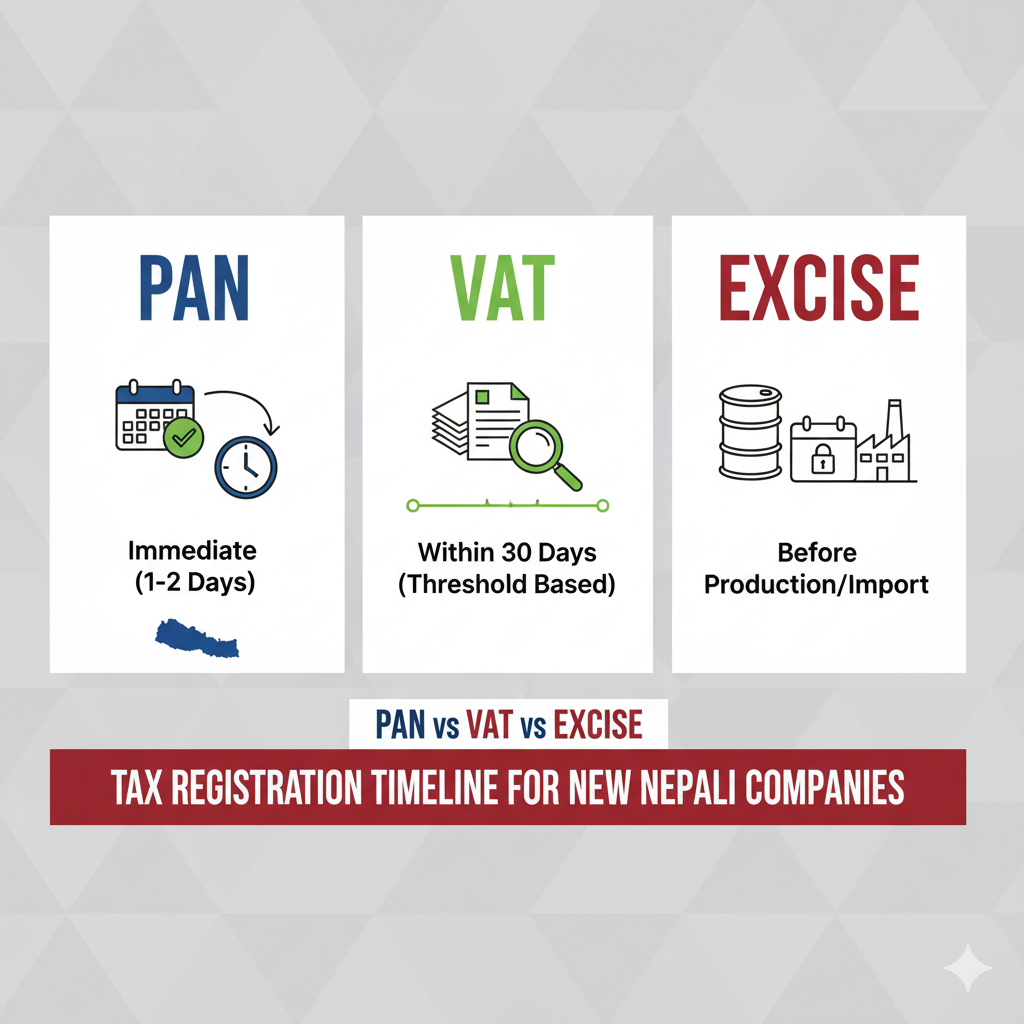
PAN vs VAT vs EXCISE: Tax Registration Timeline for New Nepali Companies
14
Nov
Establishing a new private limited company in Nepal necessitates strict adherence to tax regulations. Following incorporation with the Office of the Company Registrar (OCR), the immediate next step is tax registration. The primary tax registrations involve the Permanent Account Number (PAN), Value Added Tax (VAT), and Excise Duty. Each serves a distinct purpose under the purview of the Inland Revenue Department (IRD). Understanding the specific requirements, governing laws like the Income Tax Act, 2058, and the correct sequence for this tax registration timeline is fundamental for legal compliance and smooth business operations. This article provides a factual breakdown of these three core tax registrations for new Nepali companies.
Understanding the Core Tax Registrations in Nepal
Before initiating the registration process, it is essential to differentiate between PAN, VAT, and Excise Duty. While all are administered by the IRD, their applicability, purpose, and governing legal frameworks differ significantly. A clear understanding of these differences is the first step for any company to determine its specific tax liabilities and ensure compliance from the outset.
Permanent Account Number (PAN) Registration
The Permanent Account Number (PAN) is a unique 10-digit alphanumeric identifier issued by the IRD. It is the foundational tax ID for any entity, including individuals and companies, operating in Nepal. Under the Income Tax Act, 2058, obtaining a PAN is mandatory for all companies before commencing any business, financial, or investment activities. The PAN serves as a universal identifier for all tax-related matters, including filing income tax returns, conducting transactions, and opening bank accounts. It is the first and most non-negotiable registration for a new company.
Value Added Tax (VAT) Registration
Value Added Tax (VAT) is a consumption-based tax levied on the sale of goods and the provision of services within Nepal. Governed by the Value Added Tax Act, 2052, VAT registration is not mandatory for all businesses from day one. It becomes compulsory when a company's annual turnover from the supply of taxable goods and services exceeds a specific threshold set by the government in the annual fiscal budget. Companies can also opt for voluntary VAT registration to claim input tax credits on their business purchases, which can be financially advantageous.
Excise Duty Registration
Excise Duty is a specific type of tax imposed on the production, import, and sale of particular goods, often referred to as "excisable goods." These goods typically include items like alcohol, tobacco products, cigarettes, and certain petroleum products. The Excise Duty Act, 2058 governs this tax. Registration for excise duty is not a general requirement but is mandatory only for companies involved in the manufacturing, bottling, or importing of these specific goods. This registration is highly industry-specific and involves additional compliance measures, such as maintaining records of production and stock.
The Tax Registration Timeline and Process for a New Company
The process of tax registration follows a logical sequence. A new company must first secure its universal identifier (PAN) before it can assess its liability for other taxes like VAT. This timeline ensures a structured approach to becoming fully tax-compliant. The process begins immediately after the company receives its Certificate of Incorporation from the OCR.
Step 1: Immediate Action - PAN Registration
The first and most urgent step in the tax registration timeline is applying for a corporate PAN. This should be done immediately after receiving the Certificate of Incorporation. The application, submitted to the IRD office, requires the company's incorporation documents, details of directors, and the company's official address. The PAN certificate is typically issued within a few days if all documents are in order. Without a PAN, a company cannot legally open a corporate bank account, invoice clients, or conduct any significant financial transaction, making it the prerequisite for all subsequent business activities.
Step 2: Assessing VAT Liability Within the First Fiscal Year
After obtaining the PAN, the company must assess its potential for VAT liability. This involves forecasting the annual turnover from its business operations. The management must realistically project whether the total sales of goods and services will cross the VAT threshold within the current fiscal year. This assessment is critical because it determines the urgency and necessity of VAT registration. The threshold is subject to change, so companies must refer to the latest Finance Act for the current limits.
Step 3: Mandatory or Voluntary VAT Registration
Based on the turnover assessment, the company proceeds with VAT registration. If the projected or actual turnover exceeds the government-mandated threshold, registration with the IRD is mandatory within the specified timeframe, typically 30 days of crossing the limit. Failure to do so results in penalties. If the turnover is below the threshold, the company has the option to register voluntarily. Voluntary registration allows the company to charge VAT on its supplies and, more importantly, claim a refund for the VAT paid on its business purchases (input tax credit).
Step 4: Excise Duty Registration for Applicable Industries
For companies in specific sectors like alcohol production or tobacco import, excise duty registration runs parallel to the PAN and VAT processes. This registration is not based on turnover but on the nature of the business activity. The application must be filed with the specific excise division of the IRD. The process involves providing detailed information about manufacturing facilities, storage warehouses, and machinery. This registration must be completed before the company commences any production or import of excisable goods.
Detailed Procedures and Required Documents
The practical execution of tax registration requires meticulous preparation and submission of specific documents to the IRD. Accuracy and completeness are vital to avoid delays. Below are the detailed procedures and necessary paperwork for PAN and VAT registration, the two most common registrations for new companies.
Procedure for PAN Registration
The process for obtaining a corporate PAN is straightforward. The company must fill out the PAN registration form (PAN application form for companies), which is available at the IRD office or online. The duly filled form, along with the required documents, must be submitted to the IRD counter. Upon verification, the IRD issues a PAN certificate. This certificate contains the company's PAN, which must be printed on all official documents, including invoices, letterheads, and tax returns.
- Required Documents for PAN Registration:
- A copy of the Certificate of Incorporation issued by the OCR.
- A copy of the Memorandum of Association (MOA) and Articles of Association (AOA).
- Copies of citizenship certificates of all directors.
- A recent passport-sized photograph of the authorized signatory.
- The company's registered office address proof (rental agreement or ownership deed).
- Details of the company's bank account.
Procedure for VAT Registration
VAT registration follows a similar submission process to the IRD. The company must complete the VAT registration form, providing details of its economic activities, expected annual turnover, and information on its business premises. The IRD may conduct a physical inspection of the business premises to verify the information provided. After successful verification, the IRD issues a VAT registration certificate, which includes the company's VAT number. This number must be displayed prominently at the place of business.
- Required Documents for VAT Registration:
- The original PAN Certificate of the company.
- A copy of the Certificate of Incorporation.
- A copy of the MOA and AOA.
- Details of the company's bank account.
- A declaration of the expected annual turnover.
- Proof of business premises address (rental agreement or ownership deed).
- Copies of citizenship certificates of directors and the authorized person.
Comparative Analysis: PAN vs. VAT vs. Excise at a Glance
| Feature | Permanent Account Number (PAN) | Value Added Tax (VAT) | Excise Duty |
|---|---|---|---|
| Governing Act | Income Tax Act, 2058 | Value Added Tax Act, 2052 | Excise Duty Act, 2058 |
| Issuing Authority | Inland Revenue Department (IRD) | Inland Revenue Department (IRD) | Inland Revenue Department (IRD) |
| Applicability | Mandatory for all companies. | Mandatory if turnover exceeds threshold; optional otherwise. | Mandatory for specific industries (e.g., alcohol, tobacco). |
| Registration Trigger | Company Incorporation. | Exceeding turnover threshold or voluntary choice. | Commencement of production/import of excisable goods. |
| Primary Purpose | Universal tax ID for all tax matters. | Tax on consumption of goods and services. | Tax on specific goods (production/import). |
| Frequency of Filing | Annual Income Tax Return. | Monthly VAT Return. | Monthly Excise Return. |
Post-Registration Tax Compliance
Obtaining the necessary tax registrations is only the beginning. A new company must adhere to ongoing compliance requirements to maintain good standing with the IRD. This involves regular filing of returns and maintaining proper books of accounts. For PAN, an annual income tax return must be filed, detailing the company's income, expenses, and tax liability for the fiscal year. For VAT, registered companies must file monthly returns, showing the VAT collected on sales and the VAT paid on purchases. Similarly, companies registered for excise duty must file monthly returns detailing their production and sales. Timely compliance is essential to avoid penalties and legal complications.
Frequently Asked Questions (FAQs)
1. Is PAN registration compulsory for all new companies in Nepal? Yes, PAN registration is mandatory for every company under the Income Tax Act, 2058. It is required before starting any business operations.
2. What is the current VAT registration threshold in Nepal? The threshold changes with the annual budget. As of the latest fiscal year, it is typically NPR 40 lakh for goods and NPR 20 lakh for services. Always verify with the IRD.
3. Can a company register for VAT voluntarily? Yes, a company can register for VAT voluntarily even if its turnover is below the mandatory threshold to claim input tax credits.
4. Who needs to register for Excise Duty in Nepal? Only companies involved in manufacturing, importing, or dealing in specific goods listed under the Excise Duty Act, 2058, like alcohol and tobacco, must register.
5. What happens if a company fails to register for VAT on time? Failure to register for VAT within the stipulated time after exceeding the turnover threshold attracts financial penalties and interest charges as per the VAT Act, 2052.
6. How long does it take to get a PAN certificate after application? If all submitted documents are correct and complete, the IRD typically issues the PAN certificate within 2 to 5 working days.