- [email protected]
- Anamnagar Kathmandu

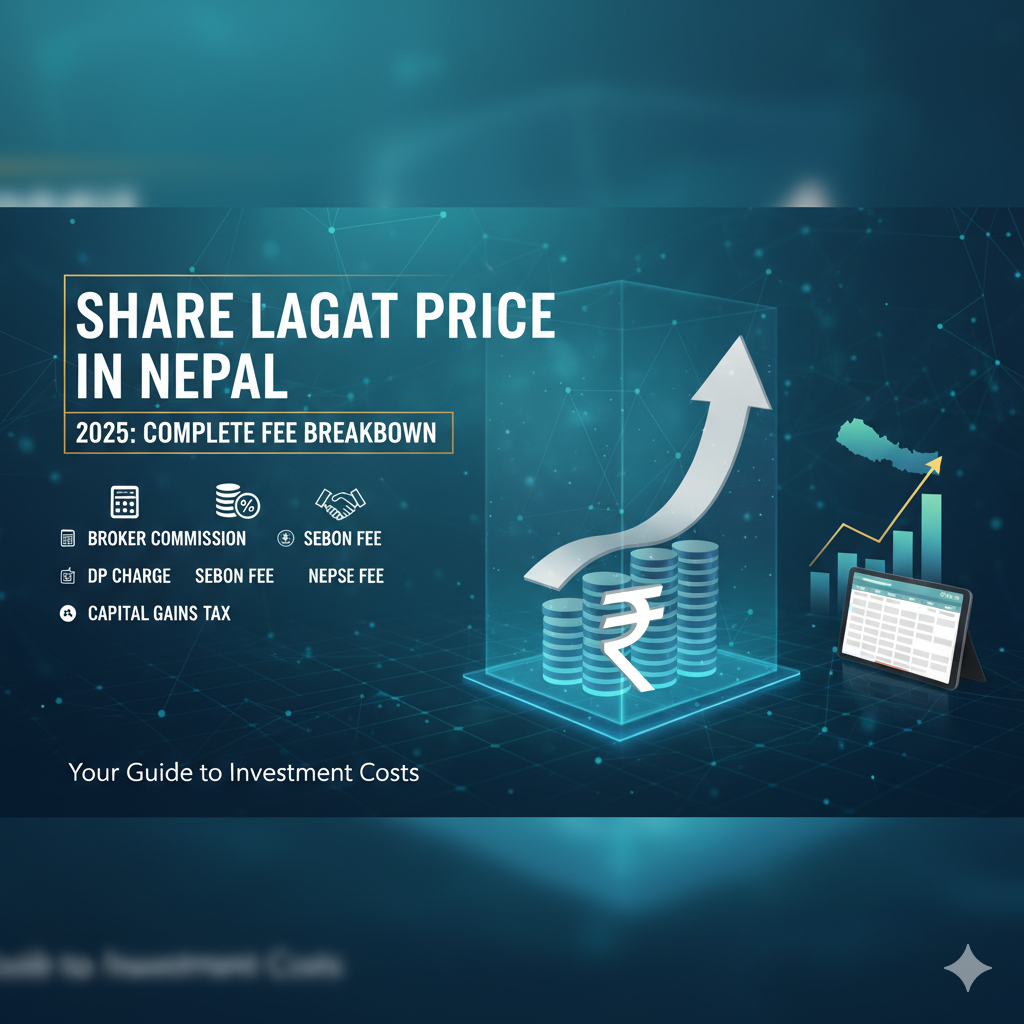
Share Lagat Price in Nepal 2025
16
Nov
Introduction: Understanding Share Lagat Price in Nepal 2025
In Nepal's evolving stock market, a comprehensive understanding of transaction costs is considered essential for every investor. The complete Share Lagat Price in Nepal 2025 is comprised of three primary components that must be carefully analyzed. These stock transaction costs are regulated by the Securities Board of Nepal (SEBON) and implemented through the Nepal Stock Exchange (NEPSE). Furthermore, these equity trading expenses directly impact investment returns and must be factored into all trading strategies. This definitive guide has been created to provide a detailed breakdown of all associated charges. By the end of this article, the complete structure of share dealing costs will be made clear.
The Three Pillars of Share Transaction Costs
Every share transaction in Nepal is subjected to a specific fee structure that has been established by regulatory bodies. The total Share Lagat Price is calculated by summing three distinct charges: broker commission, SEBON charges, and DP fees. Each component serves a different purpose within the trading ecosystem and is levied by different entities. These securities transaction charges are applied to both buy and sell orders, affecting the overall profitability of trades. A clear understanding of these capital market levies is therefore considered fundamental for successful investing. The following sections will examine each component in detail.
What Are the Broker Fees for Share Trading in Nepal 2025?
The broker commission represents the fee charged by licensed stockbrokers for executing buy and sell orders on behalf of investors. In Nepal 2025, these commissions are typically calculated as a percentage of the total transaction value. The rates can vary between brokerage firms but are generally standardized within a specific range. For retail investors, the commission is usually set between 0.4% to 0.6% of the transaction value. Additionally, a minimum commission charge is often applied for smaller transactions to ensure profitability for the broker. High-volume traders may be offered discounted rates, as their business is valued by brokerage firms. These trading commission Nepal rates represent the largest variable component of share transfer fees.
Table 1: Broker Commission Fee Structure (2025)
| Transaction Value (Rs.) | Commission Rate (%) | Minimum Charge (Rs.) | Notes |
|---|---|---|---|
| Up to 50,000 | 0.60% | 25 | Standard retail rate |
| 50,001 - 500,000 | 0.50% | 25 | Decreasing percentage structure |
| 500,001 - 2,000,000 | 0.45% | 25 | Preferred client rate |
| Above 2,000,000 | 0.40% | 25 | Negotiable for high-volume traders |
| Institutional | 0.35% - 0.40% | 100 | Special rates for institutions |
How Much Does SEBON Charge for Share Transactions?
SEBON charges are regulatory fees levied by the Securities Board of Nepal on all securities transactions conducted through NEPSE. These charges are considered share registration fees that fund the regulatory activities of the market watchdog. Unlike broker commission, SEBON's rates are standardized across all brokerage firms and cannot be negotiated. The charges are applied separately to both buy and sell transactions, effectively doubling the regulatory cost for a complete trade cycle. In Nepal 2025, the SEBON levy has been maintained at a specific percentage of the transaction value to support market development initiatives. These securities transaction charges are automatically deducted during the settlement process. The funds collected through these capital market levies are utilized for market supervision, investor protection, and development of the securities market.
Table 2: SEBON Regulatory Charges (2025)
| Transaction Type | Charge Rate (%) | Basis of Calculation |
|---|---|---|
| Buy Transaction | 0.00015% | Total transaction value |
| Sell Transaction | 0.00015% | Total transaction value |
| Initial Public Offering (IPO) | 0.00015% | Total application value |
| Rights Offering | 0.00015% | Total subscription value |
A Detailed Look at Depository Participant (DP) Charges in Nepal
The third component of Share Lagat Price consists of DP fees, which are charged by Depository Participants for maintaining dematerialized share accounts. In Nepal's modern trading system, all securities are held in electronic form through the Central Depository System (CDS). These DP fees cover various services including account opening, annual maintenance, and transaction settlement. For each trade, a specific settlement charge is applied by the DP to facilitate the transfer of securities. Additionally, annual maintenance fees are charged to keep the demat account active, regardless of trading activity. The process of converting physical share certificates to electronic form (dematerialization) or vice versa (rematerialization) also incurs separate charges. These stock market fees are standardized across most DPs but may vary slightly between service providers.
Table 3: Common DP Fee Structure (2025)
| Service Type | Typical Cost (Rs.) | Frequency |
|---|---|---|
| Account Opening | 100 - 250 | One-time |
| Annual Maintenance | 300 - 500 | Yearly |
| Transaction Settlement | 10 - 25 | Per transaction |
| Dematerialization | 5 - 10 | Per certificate |
| Rematerialization | 15 - 25 | Per certificate |
| Pledge Creation | 50 - 100 | Per pledge |
Calculating Your Total Share Lagat Price: A Practical Example
To illustrate how these costs combine, a practical example of a share purchase worth Rs. 100,000 will be examined. First, the broker commission would be calculated at 0.5% of the transaction value, resulting in Rs. 500. Next, the SEBON charges would be applied at 0.00015%, amounting to Rs. 15. Finally, the DP fees for settlement would be approximately Rs. 20 for this transaction. Therefore, the total Share Lagat Price for buying Rs. 100,000 worth of shares would be Rs. 535 (Rs. 500 + Rs. 15 + Rs. 20). When these shares are eventually sold, a similar set of charges would again be applied, affecting the net profit or loss on the investment. This calculation demonstrates how NEPSE trading costs can accumulate and impact overall returns.
How to Minimize Your Stock Transaction Costs in Nepal
While these charges are mandatory, several strategies can be employed to reduce the overall Share Lagat Price. First, broker commission rates can often be negotiated, especially for high-volume traders or those with large portfolios. Second, selecting a DP with competitive DP fees and lower annual maintenance charges can result in significant savings over time. Third, consolidating multiple small transactions into fewer larger trades can minimize the impact of minimum charges and per-transaction fees. Additionally, investors are encouraged to compare the complete fee structures of different brokers rather than focusing solely on commission rates. By implementing these strategies, the equity trading expenses can be effectively managed and optimized. Such careful consideration of share dealing costs is characteristic of savvy investors in Nepal 2025.
Frequently Asked Questions (FAQ) About Share Lagat Price in Nepal 2025
What is the total cost of buying shares in Nepal?
The total cost is comprised of broker commission (0.4%-0.6%), SEBON charges (0.00015%), and DP fees (Rs. 10-25 per transaction). These components together form the complete Share Lagat Price in Nepal 2025.
How are broker commission fees calculated?
Broker commission is calculated as a percentage of the total transaction value. The rate typically ranges from 0.4% to 0.6%, with minimum charges applied for small transactions.
What percentage does SEBON charge on share transactions?
SEBON charges are levied at 0.00015% of the transaction value for both buy and sell orders. These regulatory fees are standardized across all brokers.
Are DP charges the same for all brokers?
While basic DP fees are standardized, some variation exists between service providers. Investors are advised to compare annual maintenance charges and settlement fees before opening an account.
How can share trading costs be minimized?
Costs can be minimized by negotiating broker commission, consolidating trades, and selecting DPs with competitive fees. High-volume traders may qualify for preferential rates.
What hidden fees exist in NEPSE trading?
Beyond the obvious charges, investors should be aware of annual demat account maintenance fees, pledge creation charges, and potential fees for failed transactions. These additional costs impact overall NEPSE trading costs.
Do share selling costs differ from buying costs?
The fee structure is generally the same for both buying and selling transactions. However, some brokers may offer slightly different commission rates for sell orders, and share transfer fees apply to both transaction types.
Conclusion: Mastering Share Transaction Costs in Nepal 2025
A thorough understanding of Share Lagat Price in Nepal 2025 is considered indispensable for successful investing in the Nepali stock market. The three components of broker commission, SEBON charges, and DP fees must be carefully calculated and incorporated into all investment decisions. By being aware of these stock transaction costs, investors can more accurately calculate their potential returns and make more informed trading choices. The competitive landscape among brokers and DPs in Nepal 2025 provides opportunities for investors to minimize their equity trading expenses through careful selection and negotiation.
For personalized cost calculations and expert broker consultation, contact our team today or use our interactive NEPSE trading costs calculator. Our specialists are ready to help you optimize your trading strategy and minimize your share dealing costs in Nepal's dynamic stock market. Take control of your investment expenses today by becoming an informed trader who understands every component of the Share Lagat Price.