- [email protected]
- Anamnagar Kathmandu

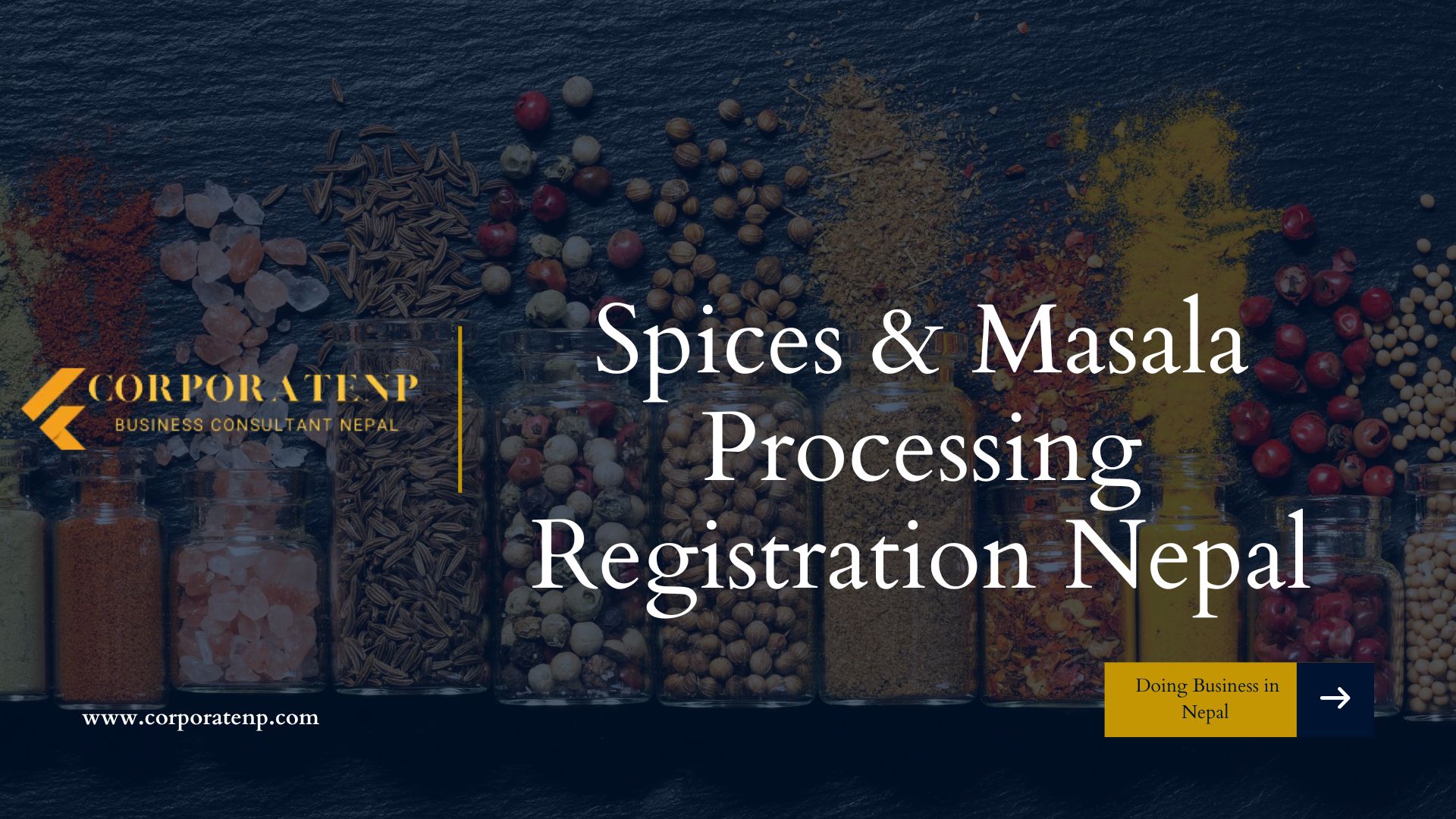
Spices & Masala Processing Registration Nepal
27
Jun
Spices and Masala Processing Registration in Nepal is a mandatory legal process for entrepreneurs who intend to produce, package, and distribute turmeric powder, chili powder, garam masala, curry masala, cumin, coriander, and other blended or ground spice products. The Department of Food Technology and Quality Control (DFTQC) under the Ministry of Agriculture and Livestock Development regulates all food processing activities in Nepal. Without proper DFTQC licensing and business registration, no spice or masala processing operation is permitted to function legally.
The Spices and Masala Processing Registration in Nepal process involves multiple government authorities. Company registration at the Office of the Company Registrar (OCR), PAN and VAT registration at the Inland Revenue Department, industry registration, ward office clearance, and DFTQC food processing license must all be obtained. Additionally, spice and masala production must comply with Good Manufacturing Practices (GMP), Good Hygiene Practices (GHP), and specific Nepal Bureau of Standards and Metrology (NBSM) standards.
In this comprehensive guide, the entire registration and setup process is explained step by step. Legal frameworks, factory infrastructure requirements, documentation, costs, timelines, and post-registration compliance are covered thoroughly. This tutorial is designed for entrepreneurs, investors, and existing food businesses seeking to enter or expand in Nepal's spice and masala processing sector.
Why Spices and Masala Processing Registration in Nepal Is Essential
Spices and Masala Processing Registration in Nepal is essential because the spice market in Nepal is deeply rooted in culinary tradition and daily consumption. From household kitchens to restaurants and food industries, masala products are used universally. Major players like Eastern Condiments, MDH, Everest, and numerous local brands such as Mheecha, Gorkha Masala, and Bhrikuti Masala dominate the market. New entrants must compete not only on flavor and price but also on regulatory compliance and quality assurance.
The Food Hygiene and Quality Act 2081, which replaced the 57-year-old Food Act 2023, has introduced stricter hygiene mandates, enhanced quality assurance processes, and stronger enforcement mechanisms. Under this Act, all food businesses must obtain DFTQC registration before commencing production. Operating without a license can result in fines up to NPR 500,000, imprisonment up to 5 years, or both. Product seizure and business closure are also enforced.
Therefore, proper registration is not merely a formality. It is the foundation of legal operation, consumer trust, and market access for spice and masala products in Nepal.
Legal Framework for Spices and Masala Processing Registration in Nepal
The Spices and Masala Processing Registration in Nepal process is governed by a comprehensive legal framework. Understanding these laws ensures that your processing unit and products meet all regulatory requirements.
| Law/Regulation | Key Provisions |
|---|---|
| Food Act 2023 (1966) | Prohibits adulteration; mandates licensing for food production |
| Food Hygiene and Quality Act 2081 (2024) | Modernized framework for hygiene, quality, and safety standards |
| Food Regulation 2027 (1970) | Detailed licensing, inspection, and labeling procedures |
| Companies Act 2063 | Business entity registration and corporate governance |
| Industrial Enterprises Act 2076 | Industry registration and operation requirements |
| Income Tax Act 2058 | Taxation of processing income |
| VAT Act 2052 | Value-added tax on spice sales |
| Consumer Protection Act 2075 | Consumer rights and product liability |
| Nepal Standard (NS) 98:2042 | Hygienic conditions in food industries |
| NBSM Product Certification Scheme | Product-specific standards and marking requirements |
The Food Hygiene and Quality Act 2081 was certified on May 5, 2024, and became effective on August 3, 2024. This Act aligns Nepal's food industry with international Codex Alimentarius standards and introduces mandatory registration with 2-year license validity for most categories.
Business Structure Options for Spice and Masala Processing
Before initiating Spices and Masala Processing Registration in Nepal, the appropriate business structure must be selected.
| Structure | Best For | Minimum Capital | Liability |
|---|---|---|---|
| Private Limited Company | Medium to large processing units | NPR 100,000 | Limited to share capital |
| Public Limited Company | Large-scale production | NPR 10,000,000 | Limited to share capital |
| Partnership Firm | Family-owned units | No minimum | Joint and several |
| Sole Proprietorship | Cottage-level production | No minimum | Unlimited personal |
For spice and masala processing, a private limited company is recommended. It limits liability, facilitates bank financing, and meets DFTQC expectations for organized food businesses.
Step-by-Step Spices and Masala Processing Registration in Nepal
The Spices and Masala Processing Registration in Nepal process follows a sequential path through multiple authorities.
Step 1: Company Registration at OCR
A private or public limited company is registered through the CAMIS portal at ocr.gov.np. The Memorandum of Association must specify food processing, spice manufacturing, and trading as business objectives.
| Requirement | Details |
|---|---|
| Name reservation | NPR 100 fee, 35-day validity |
| Minimum shareholders | 1 for private, 7 for public |
| Paid-up capital | NPR 100,000 minimum |
| Timeline | 5-7 working days |
| Cost | NPR 15,000-45,000 |
Step 2: PAN and VAT Registration
PAN is obtained from the Inland Revenue Department free of charge. VAT registration is mandatory for processing businesses regardless of turnover threshold, as spice production is classified as a taxable supply.
| Requirement | Details |
|---|---|
| PAN registration | Free, 1-3 working days |
| VAT registration | Free, 3-7 working days |
| Documents | Citizenship, photos, company registration |
Step 3: Ward Office Registration
The processing premises must be registered at the local ward office. A trade license or recommendation letter is obtained. Fees range from NPR 8,000 to 15,000 depending on unit size and location.
Step 4: Industry Registration
For processing operations, registration with the Department of Industry or provincial industry registration body is required under the Industrial Enterprises Act 2076. This registration is a prerequisite for DFTQC recommendation.
Step 5: DFTQC Processing License Application
The DFTQC license is the core requirement for Spices and Masala Processing Registration in Nepal. Applications are submitted through the NeFFILS digital portal at neffils.dftqc.gov.np.
| DFTQC License Category | Application Fee | Inspection Fee | Total Government Fee |
|---|---|---|---|
| Category A (Manufacturing) | NPR 25,000 | NPR 10,000 | NPR 35,000 |
| Category B (Processing) | NPR 15,000 | NPR 7,000 | NPR 22,000 |
Step 6: Factory Infrastructure Setup
The processing unit must be constructed and equipped before DFTQC inspection. Specific requirements for spice and masala processing include:
| Infrastructure Component | Requirement |
|---|---|
| Production floor | Smooth, washable, non-absorbent surfaces |
| Raw material storage | Dry, ventilated, pest-free area with humidity control |
| Finished goods storage | Airtight, temperature-controlled, hygienic conditions |
| Water supply | Clean, potable, tested for quality |
| Waste disposal | Proper drainage and effluent treatment |
| Changing rooms | Separate for workers with hand-washing facilities |
| Equipment sanitation | Routine cleaning chart implemented |
| Pest control | Integrated pest management system |
| Grinding and blending area | Dust extraction and ventilation systems |
Step 7: GMP and GHP Compliance
Good Manufacturing Practices and Good Hygiene Practices must be implemented. DFTQC inspectors evaluate:
| GMP/GHP Area | Compliance Standard |
|---|---|
| Facility design and layout | Proper workflow from raw to finished goods |
| Equipment maintenance | Regular calibration and cleaning of grinders and blenders |
| Personnel hygiene | Clean clothing, head-covers, gloves, health checks |
| Production controls | Standardized recipes and process documentation |
| Quality control procedures | In-house or third-party testing protocols |
| Water quality management | Regular testing for microbiological safety |
| Waste management | Segregated disposal, no cross-contamination |
| Allergen control | Separate processing lines for different spices |
Step 8: Product Registration and Laboratory Testing
Each spice and masala product must be individually registered with DFTQC. Product samples are submitted for laboratory testing.
| Test Parameter | Purpose |
|---|---|
| Microbiological analysis | Bacterial count, pathogen screening, mold detection |
| Chemical analysis | Additive levels, preservative compliance |
| Contaminant screening | Aflatoxin, pesticide residues, heavy metals |
| Nutritional labeling | Calorie, protein, fat, carbohydrate verification |
| Moisture content | Shelf stability assessment |
| Foreign matter detection | Purity and adulteration check |
Testing is conducted at DFTQC laboratories or accredited private labs. Fees range from NPR 2,000 to 10,000 per product.
Step 9: DFTQC Inspection
An on-site inspection is scheduled after document review. Inspectors assess:
- Hygiene and sanitation of premises
- Production process flow
- Storage conditions
- Quality control measures
- Staff training and hygiene practices
- Labeling compliance
- Dust control and ventilation
Step 10: License Issuance
Upon satisfactory compliance, the DFTQC processing license is issued digitally through NeFFILS. The license is product-specific and valid for 1 to 3 years depending on the category.
Nepal Standard for Spices and Masala (NBSM Certification)
Spices and masala products manufactured in Nepal must comply with Nepal Standard specifications. The Nepal Bureau of Standards and Metrology has established specific requirements under its Product Certification Scheme.
| Standard Requirement | Details |
|---|---|
| Premises hygiene | NS 98:2042 Code for hygienic conditions in food industries |
| Raw material quality | Whole spices must meet corresponding NS for purity |
| Production control | Control unit defined as one shift production of same type |
| Testing frequency | Regular analysis at specified levels of control |
| Labeling | Batch number, manufacturing date, best before, net weight |
| Standard Mark | Eligible products may bear the NBSM Standard Mark |
The licensee must maintain records of rejected control units and their disposal. Reprocessed material must be retested before marking.
Labeling Requirements for Spices and Masala in Nepal
Under the Food Hygiene and Quality Act 2081, all packaged food must carry specific labeling information. Non-compliance attracts penalties of NPR 100,000.
| Mandatory Label Information | Requirement |
|---|---|
| Product name | "Turmeric Powder," "Garam Masala," or specific variant |
| Manufacturer name and address | Complete registered business address |
| Net weight/volume | Exact quantity in metric units |
| Batch/lot number | Traceability code |
| Manufacturing date | Month and year |
| Best before date | Expiry indication |
| Ingredients list | All components in descending order |
| Nutritional information | Calories, protein, fat, carbohydrates, sodium |
| Storage instructions | Proper handling and storage conditions |
| DFTQC registration number | License identifier |
| Language | Nepali and English mandatory |
Cost Breakdown for Spices and Masala Processing Registration in Nepal
| Cost Item | Amount (NPR) |
|---|---|
| Company registration (OCR) | 15,000-45,000 |
| PAN/VAT registration | 1,000-3,000 |
| Ward office registration | 8,000-15,000 |
| Industry registration | 5,000-10,000 |
| DFTQC processing license | 22,000-35,000 |
| Product registration (per SKU) | 5,000-15,000 |
| Laboratory testing (per product) | 2,000-10,000 |
| Professional/consultancy fees | 20,000-50,000 |
| Factory infrastructure (minimum) | 400,000-1,500,000 |
| Equipment (grinders, blenders, roasters, packaging) | 800,000-4,000,000 |
| GMP/HACCP implementation | 100,000-300,000 |
| Total Registration Cost | 128,000-2,393,000 |
| Total Setup Cost (with factory) | 1.3 million - 6.4 million+ |
Timeline for Spices and Masala Processing Registration in Nepal
| Stage | Duration |
|---|---|
| Company registration | 5-7 days |
| PAN/VAT registration | 3-7 days |
| Ward office registration | 1-3 days |
| Industry registration | 7-14 days |
| Factory setup and equipment | 25-45 days |
| DFTQC application and document review | 5-7 days |
| On-site inspection scheduling | 3-5 days |
| Laboratory testing | 7-14 days |
| Final evaluation and license issuance | 3-5 days |
| Total Timeline | 2-4 months |
Post-Registration Compliance for Spice and Masala Processors
After completing Spices and Masala Processing Registration in Nepal, ongoing compliance is mandatory.
| Compliance | Frequency | Details |
|---|---|---|
| DFTQC license renewal | 1-3 years | Before expiry with updated documents |
| Annual company return | Annual | Poush end (mid-January) |
| Income tax return | Annual | Within 3 months of FY end |
| VAT return | Monthly | 25th of following month |
| Production records | Daily | Batch-wise documentation |
| Quality control testing | Per batch | Internal or third-party lab |
| Staff health checks | Annual | Communicable disease screening |
| Hygiene audits | Quarterly | Internal GMP/GHP verification |
| Tax board display | Continuous | At processing premises |
Penalties for Non-Compliance in Spice and Masala Processing
The Food Hygiene and Quality Act 2081 imposes strict penalties for violations.
| Violation | Penalty |
|---|---|
| Operating without DFTQC license | Up to NPR 500,000 fine and/or 5 years imprisonment |
| Selling adulterated spices | Up to NPR 500,000 fine and/or 5 years imprisonment |
| Mislabeling products | Up to NPR 100,000 fine |
| Importing spices without approval | NPR 50,000 fine |
| Exporting without quality certification | Up to NPR 300,000 fine and/or 6 months imprisonment |
| Product seizure and destruction | Mandatory for non-compliant batches |
HACCP and Advanced Quality Systems
While basic GMP/GHP compliance is mandatory for DFTQC licensing, advanced quality systems are recommended for competitive advantage.
| Quality System | Benefits | Implementation Cost |
|---|---|---|
| HACCP (Hazard Analysis) | Systematic hazard control, export readiness | NPR 200,000-500,000 |
| ISO 22000 | International food safety management | NPR 300,000-800,000 |
| ISO 9001 | Quality management certification | NPR 250,000-600,000 |
| NBSM Standard Mark | Consumer trust, market differentiation | Certification fee-based |
The DFTQC is voluntarily implementing HACCP in selected industries and identifying critical control points to minimize health risks. Spice and masala processors are encouraged to adopt these systems for export competitiveness.
Common Challenges in Spices and Masala Processing Registration in Nepal
| Challenge | Impact | Solution |
|---|---|---|
| Complex multi-agency process | Delays and confusion | Engage professional consultants |
| High infrastructure costs | Capital intensity | Start with essential GMP and scale up |
| Laboratory testing delays | Product launch postponement | Submit samples early with complete documentation |
| Staff hygiene compliance | Inspection failures | Implement regular training programs |
| Labeling non-compliance | Penalties and product recalls | Use standardized label templates |
| Raw material quality variation | Product inconsistency | Source from certified suppliers with test reports |
| Dust and ventilation control | Workplace safety issues | Install proper extraction systems |
How to Choose the Right Service Provider for Spices and Masala Processing Registration in Nepal
Professional assistance is highly recommended for Spices and Masala Processing Registration in Nepal. When selecting a service provider, consider:
- Experience with DFTQC licensing and NeFFILS portal
- Knowledge of food processing regulations and NBSM standards
- Track record of successful processing unit registrations
- Understanding of GMP, GHP, and HACCP implementation
- Post-registration compliance support
CorporateNp provides comprehensive services for Spices and Masala Processing Registration in Nepal. From company incorporation and DFTQC license application to factory layout planning, GMP compliance guidance, and ongoing regulatory support, every aspect is handled professionally. Expert advisors ensure that your spice and masala processing business meets all legal requirements and is positioned for market success.
Contact CorporateNp today to begin your Spices and Masala Processing Registration in Nepal and launch your food processing business with full regulatory compliance.
Frequently Asked Questions About Spices and Masala Processing Registration in Nepal
What is spices and masala processing registration in Nepal?
Spices and Masala Processing Registration in Nepal is the legal process of obtaining licenses and registrations required to produce, package, and distribute turmeric powder, chili powder, garam masala, curry masala, and other spice products. It includes company registration, DFTQC food processing license, product registration, and tax compliance.
Is DFTQC license mandatory for spice and masala processing?
Yes. Under the Food Hygiene and Quality Act 2081, all food processing businesses must obtain a DFTQC license before commencing production. Operating without a license is illegal and punishable by fines up to NPR 500,000 and imprisonment up to 5 years.
What is the minimum capital required for masala processing unit registration?
For a private limited company, the minimum paid-up capital is NPR 100,000. However, practical processing unit setup requires significantly higher investment for equipment, infrastructure, and working capital.
How long does DFTQC license processing take?
The complete process takes 20 to 35 working days after complete application submission. This includes document review, inspection scheduling, on-site inspection, laboratory testing, and final evaluation.
What documents are required for DFTQC processing license?
Required documents include company registration certificate, PAN/VAT certificate, industry registration, citizenship certificate, factory layout plan, equipment list, product label samples, water test report, GMP/GHP compliance plan, and staff health certificates.
Is product registration separate from DFTQC business license?
Yes. The DFTQC business license covers the processing facility. Each individual product (such as different masala blends or spice variants) requires separate product registration with its own laboratory testing and approval.
What are the factory hygiene requirements for spice and masala processing?
Processing units must comply with GMP and GHP standards including smooth washable floors, proper ventilation and dust extraction, pest control, clean water supply, separate changing rooms, waste disposal systems, and routine sanitation procedures as per NS 98:2042.
What labeling information is mandatory for spices and masala in Nepal?
Product name, manufacturer address, net weight, batch number, manufacturing date, best before date, ingredients list, nutritional information, storage instructions, DFTQC registration number, and text in Nepali and English are mandatory.
Can I export spices and masala manufactured in Nepal?
Yes, but export quality certification must be obtained from DFTQC confirming compliance with the destination country's quality standards. Non-compliance attracts penalties up to NPR 300,000.
What is NeFFILS and how is it used?
NeFFILS is Nepal's digital food licensing system. Applications, fee payments, document uploads, inspection scheduling, and license downloads are all processed through this portal at neffils.dftqc.gov.np.
How much does it cost to register a spice and masala processing business?
Government registration costs range from NPR 128,000 to 250,000. Total setup costs including factory infrastructure and equipment range from NPR 1.3 million to 6.4 million or more depending on scale.
Is HACCP mandatory for spice and masala processing?
HACCP is not yet universally mandatory for all food processors in Nepal, but it is strongly recommended. DFTQC is implementing HACCP voluntarily in selected industries, and it is essential for export competitiveness.
What happens if my DFTQC license expires?
Operations must cease until renewal is completed. Renewal applications should be submitted 30 days before expiry with updated documents and fees. Failure to renew may result in penalties or license cancellation.
Can foreigners set up a spice and masala processing unit in Nepal?
Yes. Foreign investors can establish food processing companies with up to 100% ownership in most cases, subject to Department of Industry approval under FITTA 2075 and DFTQC licensing.
What quality standards apply specifically to spices and masala?
Spices and masala must comply with Nepal Bureau of Standards and Metrology specifications under the Product Certification Scheme. NS 98:2042 governs hygienic conditions, and specific product standards cover purity, moisture content, foreign matter, and labeling.
References
For further reading and verification, the following authoritative sources are recommended:
- Department of Food Technology and Quality Control Nepal — Official food licensing and safety authority
- NeFFILS Portal — Digital food licensing system
- Office of the Company Registrar Nepal — Business registration portal
- Inland Revenue Department Nepal — Tax registration and compliance
- Nepal Bureau of Standards and Metrology — Product standards and certification
- Ministry of Agriculture and Livestock Development — Agricultural and food policy
- Department of Industry Nepal — Industry registration
- Food Act 2023 Nepal — Food safety legislation
- FAO Food Safety Nepal — International food standards and Codex Alimentarius
- UNESCAP Trade and Environment Nepal — Regional trade and food safety analysis
- Consumer Protection Act 2075 Nepal — Consumer rights framework
- Industrial Enterprises Act 2076 Nepal — Industry operation regulations
Disclaimer: This blog is intended for informational purposes only. It does not constitute legal, tax, or food safety advice. Laws and regulations may change. Readers are advised to consult qualified legal and food safety professionals and the Department of Food Technology and Quality Control before making business decisions. CorporateNp assumes no liability for actions taken based on this information.
Service Provider: CorporateNp — Your trusted partner for food processing business registration, DFTQC licensing, factory compliance, and regulatory advisory services in Nepal. Contact us today to set up your spice and masala processing business with expert guidance and full legal compliance.