- [email protected]
- Anamnagar Kathmandu

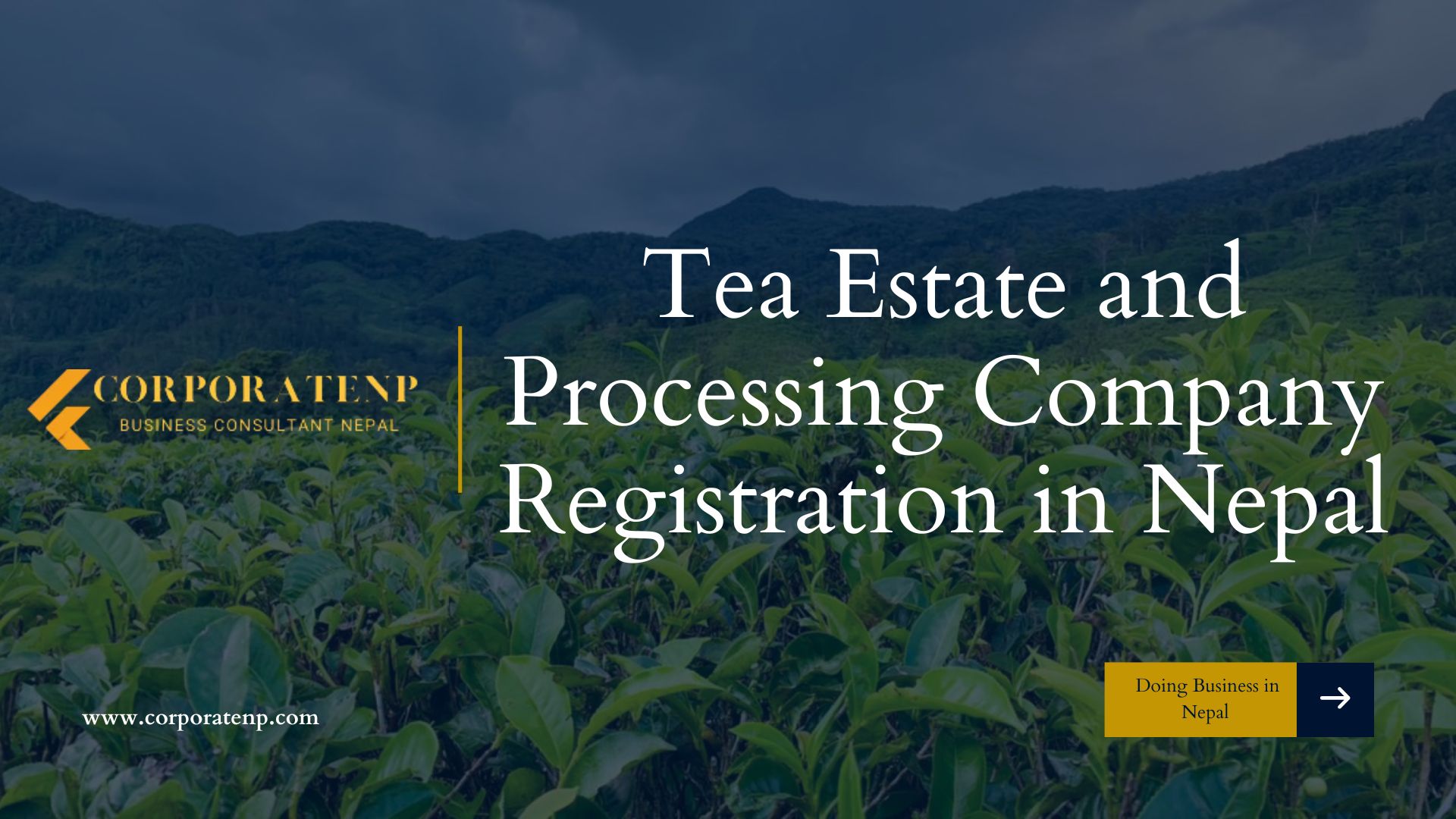
Tea Estate and Processing Company Registration in Nepal
20
Jun
Tea estate and processing company registration in Nepal is governed by multiple statutes that must be understood before any application is filed. Nepal's tea industry, particularly from the eastern hills of Ilam, Jhapa, and Panchthar, produces world-renowned orthodox and CTC teas. Many entrepreneurs are drawn to this sector by export potential and government incentives, yet remain unaware of the specific licensing requirements that apply to tea cultivation, processing, and export. This guide has been prepared to answer every question that is commonly asked about starting a tea estate and processing business in Nepal.
The legal framework for tea estate and processing company registration in Nepal is found in the Companies Act 2063, the Tea Development and Export Promotion Policy, the Industrial Enterprises Act 2076, and various standards issued by the National Tea and Coffee Development Board (NTCDB). Additionally, the Department of Food Technology and Quality Control (DFTQC) oversees processed tea quality, while the Tea Board of Nepal promotes industry standards and export facilitation.
What Is a Tea Estate and Processing Company in Nepal?
A tea estate and processing company in Nepal is a corporate entity engaged in the commercial cultivation of tea plants, harvesting of tea leaves, and processing of green leaf into finished tea products. This includes large tea estates with integrated factories, smallholder cooperative processing units, bought-leaf factories purchasing from small farmers, and value-added product manufacturers. Tea companies may operate as private limited companies, public limited companies, cooperatives, or joint ventures depending on scale and ownership structure.
Furthermore, Nepal's tea production is classified into two main categories: orthodox tea, which is hand-processed and commands premium prices in international markets, and CTC (Crush, Tear, Curl) tea, which is machine-processed for mass market consumption. Each category has distinct processing requirements, quality standards, and market positioning.
Legal Framework for Tea Estate and Processing Company Registration in Nepal
The following laws and regulations govern tea estate and processing company registration in Nepal:
| Legislation | Year | Relevance to Tea Companies |
|---|---|---|
| Companies Act | 2063 (2006) | Governs incorporation and management |
| Industrial Enterprises Act | 2076 (2020) | Industry classification and incentives |
| Tea Development and Export Promotion Policy | Various | Sector-specific development framework |
| Food Act | 2023 | Governs processed tea safety standards |
| Plant Protection Act | 2072 (2015) | Governs pest management in tea gardens |
| Pesticide Act | 2048 (1991) | Regulates agrochemical use |
| Environmental Protection Act | 2076 (2019) | Environmental compliance for estates |
| Value Added Tax Act | 2052 (1996) | Tax on tea products |
| Foreign Investment and Technology Transfer Act | 2075 (2019) | Governs foreign participation |
| Export-Import Policy | Various | Tea export procedures and incentives |
| Nepal Tea Board Regulations | Various | Quality standards and market facilitation |
Types of Tea Companies in Nepal
Tea companies may be structured in several forms:
| Company Type | Description | Regulator |
|---|---|---|
| Integrated Tea Estate | Own gardens with processing factory | NTCDB, DOI |
| Bought-Leaf Factory | Purchases green leaf from smallholders | NTCDB, DFTQC |
| Cooperative Tea Processing | Farmer-member owned units | Cooperative Dept, NTCDB |
| Value-Added Tea Company | Specialty, flavored, or packaged teas | DFTQC, NTCDB |
| Organic Tea Company | Certified organic production | NTCDB, Organic Certifier |
| Export-Focused Tea Company | International market supply | NTCDB, Customs, DFTQC |
| Tea Trading Company | Domestic and export trading | NTCDB, IRD |
Step-by-Step Process for Tea Estate and Processing Company Registration in Nepal
The tea estate and processing company registration in Nepal process involves multiple stages across different authorities.
Step 1: Land Selection and Soil Assessment
Proper land selection is critical for tea cultivation. The following factors must be assessed:
| Site Factor | Requirement |
|---|---|
| Altitude | 600-2,000 meters for quality orthodox tea |
| Slope | 15-30 degrees for drainage |
| Soil Type | Well-drained acidic soil (pH 4.5-5.5) |
| Rainfall | 1,500-3,000 mm annually, well-distributed |
| Temperature | 18-25°C optimal growing range |
| Humidity | 80% relative humidity preferred |
| Land Tenure | Lease or ownership for minimum 30 years |
| Accessibility | Road access for green leaf transport |
Step 2: Business Plan and Feasibility Study
A comprehensive business plan must be prepared covering garden development, processing capacity, product mix, market analysis, and financial projections. Key considerations include:
| Aspect | Planning Parameter |
|---|---|
| Garden Development Timeline | 4-5 years from planting to commercial harvest |
| Processing Technology | Orthodox roller, dryer, sorter, or CTC machinery |
| Capacity Planning | Green leaf intake versus factory throughput |
| Product Grading | Whole leaf, broken, fannings, dust categories |
| Market Channels | Domestic auction, direct export, retail branding |
| Organic Certification | 3-year conversion period if transitioning |
Step 3: Land Use and Lease Documentation
For tea estates, long-term land documentation is essential:
| Document | Purpose |
|---|---|
| Land Ownership Certificate | Freehold land verification |
| Lease Agreement | Minimum 30-year lease for leased land |
| Land Use Classification | Agricultural use confirmation |
| Survey Maps | Estate boundary demarcation |
| Environmental Screening | Initial environmental examination |
Step 4: Company Name Reservation at OCR
The proposed company name is reserved through the OCR e-Services Portal. Names reflecting tea, estate, or garden heritage are commonly used.
Step 5: Company Registration at OCR
The company is registered as a private limited or public limited entity. The MOA must specify tea cultivation, processing, manufacturing, and trading objectives.
| Document | Purpose |
|---|---|
| MOA and AOA | Constitutional documents |
| Promoter Identification | Citizenship or passport copies |
| Registered Office Proof | Estate office or processing unit address |
| Capital Deposit Proof | Bank deposit certificate |
| PAN Application | Tax registration initiation |
Step 6: PAN and VAT Registration at IRD
Permanent Account Number registration is completed at the Inland Revenue Department. VAT registration is required as tea products are subject to 13% VAT.
Step 7: NTCDB Registration and Licensing
The National Tea and Coffee Development Board registration is mandatory for all commercial tea operations. The application requires:
| Document | Purpose |
|---|---|
| Tea Industry Registration Application | Formal request to NTCDB |
| Company Registration Certificate | Legal entity proof |
| Land Ownership or Lease | Estate premises verification |
| Garden Development Plan | Planting schedule, area, varietals |
| Processing Facility Plan | Factory layout, machinery list, capacity |
| Water Source Details | Processing and irrigation water |
| Employment Plan | Permanent and seasonal labor requirements |
| Technical Staff Details | Tea cultivation and processing expertise |
| Quality Control Plan | Testing laboratory and grading protocols |
| Export Intent Declaration | If targeting international markets |
Step 8: NTCDB Technical Inspection
NTCDB officials conduct a site inspection to verify:
| Inspection Aspect | Standard |
|---|---|
| Garden Establishment | Proper planting density, shade trees, drainage |
| Nursery Quality | Certified planting material, pest-free stock |
| Processing Facility | Adequate withering, rolling, fermenting, drying capacity |
| Hygiene Standards | Clean processing environment, worker sanitation |
| Record Keeping | Garden log, processing batch records, traceability |
| Worker Welfare | Housing, sanitation, fair wage compliance |
| Environmental Practices | Soil conservation, water management, biodiversity |
Step 9: DFTQC Food Industry License (For Processing)
If the company engages in tea processing and packaging, DFTQC food industry license is required with compliance to food safety standards.
Step 10: Pesticide Use Registration (If Applicable)
For estates using agrochemicals, registration with the Pesticide Registration and Management Division is required. Organic estates must maintain pesticide-free records for certification.
Step 11: Organic Certification (If Applicable)
For organic tea production, certification from an accredited body is required:
| Certification Body | Standard |
|---|---|
| NASAA (Nepal) | Organic production standards |
| IMO (Switzerland) | EU organic equivalence |
| ECOCERT | International organic certification |
| USDA NOP | US organic market access |
Organic certification requires a minimum 3-year conversion period with documented organic practices.
Step 12: Industry Registration at DOI
Tea companies with fixed capital above NPR 50 lakh should register at the Department of Industry to avail tax incentives and export facilitation.
| Incentive | Benefit |
|---|---|
| Income Tax Exemption | 100% for 5 years, 50% for next 3 years |
| Customs Duty Concession | On imported processing machinery |
| VAT Exemption | On imported capital goods |
| Export Subsidy | Cash incentive on FOB value of exports |
| Subsidized Loans | From agricultural development banks |
| Technical Support | Free extension services from NTCDB |
Step 13: Export Registration (If Applicable)
For tea export, registration with the Trade and Export Promotion Centre and customs export code is required.
Tea Processing Standards in Nepal
NTCDB and international markets enforce specific processing standards:
| Process Stage | Standard Parameter |
|---|---|
| Withering | 60-70% moisture reduction over 12-18 hours |
| Rolling | Cell rupture for enzyme exposure, 20-40 minutes |
| Fermentation (Oxidation) | 2-4 hours at 20-25°C, 95% humidity |
| Drying (Firing) | Final moisture 2-3%, temperature 100-120°C |
| Sorting and Grading | By leaf size: OP, BOP, FBOP, FOP, Dust |
| Packaging | Moisture-proof, opaque, food-grade materials |
| Storage | Cool, dry, odor-free environment |
Tax Obligations for Tea Estate and Processing Companies
Tea companies are subject to the following taxes:
| Tax Type | Rate | Applicability |
|---|---|---|
| Corporate Income Tax | 25% | Standard rate |
| Corporate Income Tax (Special Industry) | 20% | If registered as special industry |
| VAT | 13% | On processed tea products |
| Agricultural Income Tax | Exempt | For primary cultivation (conditions apply) |
| Export Duty | 0% | Tea exports are duty-free |
| TDS on Green Leaf Purchase | 1.5% | On payments to smallholders |
| TDS on Employee Salaries | Progressive | As per Income Tax Act |
| Land Revenue Tax | Varies | On estate land holding |
Government Fees for Tea Estate and Processing Company Registration
| Fee Type | Amount (NPR) | Authority |
|---|---|---|
| Company Registration Fee | 1,000-3,000+ | OCR |
| NTCDB Registration | 5,000-25,000 | NTCDB |
| DFTQC License (if processing) | 5,000-25,000 | DFTQC |
| PAN Registration | Free | IRD |
| VAT Registration | Free | IRD |
| Municipal Permit | 2,000-10,000 | Local Body |
| Environmental Clearance | Varies | MoFE |
| Industry Registration | 1,000-5,000 | DOI |
| Organic Certification | 50,000-200,000 | Certifying Body |
| Export Registration | 5,000-10,000 | TEPC/Customs |
Timeline for Tea Estate and Processing Company Registration Nepal
| Stage | Duration |
|---|---|
| Land Selection and Assessment | 2-4 weeks |
| Business Plan Preparation | 2-4 weeks |
| Company Registration | 1-2 weeks |
| PAN/VAT Registration | 3-5 days |
| NTCDB Application and Inspection | 3-6 weeks |
| DFTQC License (if processing) | 2-3 weeks |
| Municipal Permit | 1-2 weeks |
| DOI Industry Registration | 1-2 weeks |
| Organic Certification (if applicable) | 3 years conversion + audit |
| Export Registration | 1-2 weeks |
| Total Timeline | 3-6 months |
Post-Registration Compliance for Tea Companies
After tea estate and processing company registration in Nepal is completed, ongoing compliance is mandatory:
| Compliance | Frequency | Authority |
|---|---|---|
| NTCDB Renewal | Annual | NTCDB |
| Garden and Factory Inspections | Periodic | NTCDB |
| Production Reporting | Annual | NTCDB |
| Pesticide Residue Testing | Periodic | DFTQC |
| Tax Return Filing | Annual | IRD |
| VAT Return Filing | Monthly/Bi-monthly | IRD |
| TDS Returns | Monthly | IRD |
| Annual Return Filing | Annual | OCR |
| DOI Reporting | Annual | DOI |
| Export Documentation | Per shipment | Customs/TEPC |
| Organic Audit (if certified) | Annual | Certifying Body |
| Environmental Monitoring | As prescribed | MoFE |
Export Market Opportunities for Nepali Tea
Nepali tea has established premium positioning in international markets:
| Export Market | Product Preference | Requirements |
|---|---|---|
| Germany | Orthodox organic, first flush | EU organic, pesticide residue compliance |
| Japan | Green tea, specialty orthodox | JAS organic, strict MRL standards |
| United States | Specialty orthodox, herbal blends | USDA organic, FDA registration |
| United Kingdom | Traditional orthodox, CTC | Ethical sourcing, Rainforest Alliance |
| India | CTC, orthodox | FSSAI compliance, bilateral agreements |
| China | Specialty, white tea | GACC registration, quality protocols |
Frequently Asked Questions
What is tea estate and processing company registration in Nepal?
Tea estate and processing company registration in Nepal is the process of establishing a legally compliant corporate entity for commercial tea cultivation, leaf processing, and product marketing, including obtaining NTCDB registration and other mandatory permits.
Is NTCDB registration mandatory for tea estates?
Yes, all commercial tea cultivation and processing operations must be registered with the National Tea and Coffee Development Board. This facilitates quality monitoring, export facilitation, and government incentive access.
What is the minimum investment for a tea estate company?
For a private limited company, the minimum paid-up capital is NPR 1,00,000. Practical investment in land development, factory establishment, and initial operations typically ranges from NPR 1 crore to 20 crore depending on estate size and processing capacity.
How long does tea estate and processing company registration take?
The complete process including company registration, NTCDB licensing, and other permits typically takes 3 to 6 months. Organic certification requires an additional 3-year conversion period.
What taxes apply to tea products in Nepal?
Processed tea is subject to 13% VAT. Corporate income tax is 25% generally, or 20% if registered as a special industry. Primary cultivation income may be exempt under agricultural income provisions. Tea exports are duty-free.
Can foreigners invest in tea companies in Nepal?
Yes, foreigners can invest in tea processing and export companies. Primary agricultural land ownership may face restrictions under FITTA and land ceiling laws. Joint venture structures with land-leasing arrangements are commonly used.
What is the difference between orthodox and CTC tea?
Orthodox tea is processed using traditional methods that preserve whole leaf structure, commanding premium prices. CTC tea is machine-processed for uniform particle size, suitable for tea bags and mass market consumption.
How long until a new tea garden becomes productive?
Tea plants typically require 4 to 5 years from planting to first commercial harvest. Full productivity is achieved after 7 to 10 years. This long gestation period requires careful financial planning.
Are government subsidies available for tea estates?
Yes, registered tea companies can avail income tax exemptions, customs duty concessions on imported machinery, VAT exemptions, export cash incentives, subsidized loans, and free technical extension services from NTCDB.
What is the Nepal Tea trademark?
The Nepal Tea trademark is a geographical indication that protects the origin and quality reputation of Nepali tea. Registered exporters may use this mark to differentiate authentic Nepal tea in international markets.
Why Choose CorporateNp for Tea Estate and Processing Company Registration Nepal?
Tea estate and processing company registration in Nepal involves navigating multiple regulators, long-term land arrangements, specialized processing standards, and complex documentation requirements. CorporateNp provides comprehensive advisory and execution services to ensure your tea company is registered smoothly and operates in full compliance.
Our services include:
- Land selection and soil assessment coordination
- Business plan and feasibility study preparation
- Company registration at OCR
- NTCDB tea industry registration application
- DFTQC food industry license support
- Organic certification guidance and documentation
- PAN, VAT, and tax registration
- Industry registration at DOI for incentives
- Municipal and environmental licensing
- Export registration and documentation
- Ongoing compliance and technical advisory
Contact CorporateNp today to begin your tea estate and processing company registration in Nepal journey with confidence.
References
For official verification and further reading, the following authoritative sources are referenced:
- National Tea and Coffee Development Board - Tea industry registration and standards
- Office of Company Registrar Nepal - Company registration
- Inland Revenue Department Nepal - Tax registration and compliance
- Department of Industry Nepal - Industry registration and incentives
- Department of Food Technology and Quality Control - Food processing standards
- Ministry of Agriculture and Livestock Development - Agricultural policy
- Ministry of Forests and Environment - Environmental clearance
- Ministry of Finance Nepal - Tax policy and export incentives
- Trade and Export Promotion Centre - Export facilitation
- Nepal Tea Board - Industry coordination and GI protection
- Food and Agriculture Organization - Global tea standards
- International Tea Committee - Global tea market data
Disclaimer: This article is provided solely for informational and educational purposes. It does not constitute legal advice, professional counsel, or solicitation. The information presented herein is based on laws and regulations as of June 2026 and may be subject to change. Readers are advised to consult qualified legal professionals before making any decisions related to tea estate and processing company registration in Nepal. CorporateNp and its affiliates shall not be held liable for any actions taken based on the contents of this guide.
Updated on: June 20, 2026