
- [email protected]
- Anamnagar Kathmandu

How to Close a Company in Nepal

25
Jul
To close a company in Nepal, you must either deregister a non-operating entity under Section 136 of the Companies Act 2063 or complete Voluntary Liquidation under Chapter 10 for active businesses. The process requires passing a shareholder special resolution (75% majority), obtaining tax clearance and PAN/VAT cancellation from the Inland Revenue Department (IRD), publishing a public notice in a national daily newspaper, settling all debts, and receiving a Certificate of Dissolution from the Office of the Company Registrar (OCR). Abandoning an inactive company leads to compounding fines and director blacklisting.
Shutting down a business is rarely the dream when you sign those incorporation papers at the Office of the Company Registrar (OCR) in Tripureshwor. But whether your venture ran its course, pivoted overseas, or simply never launched, leaving a dead company registered in Nepal is one of the most dangerous administrative mistakes a founder or director can make.
I have seen dozens of entrepreneurs walk away from dormant companies, assuming that if they just stop filing annual returns, the company quietly dissolves. It doesn’t. Instead, late fees under Section 81 of the Companies Act 2063 accumulate every single year. Eventually, directors wake up to find themselves blacklisted by the OCR, unable to register new entities, open business bank accounts, or process foreign direct investments.
Closing a Nepali private limited company (Pvt. Ltd.) cleanly requires navigating two distinct state bodies: the OCR (for corporate existence) and the Inland Revenue Department (IRD) (for tax liabilities). Here is the exact, battle-tested framework for closing a company in Nepal without falling into long-term legal traps.
1. Which Closure Path Fits Your Company?
Companies in Nepal must choose between Voluntary Deregistration (Darta Khareji) under Section 136 for dormant or non-started entities, and Voluntary Liquidation under Chapter 10 for companies with historical transactions. Insolvent companies that cannot satisfy their liabilities must instead undergo court-ordered Compulsory Liquidation under the Insolvency Act 2063.
Nepal’s corporate legal framework separates company closures based on operational history and solvency. Selecting the wrong path early will waste months in back-and-forth rejections at the OCR counter.
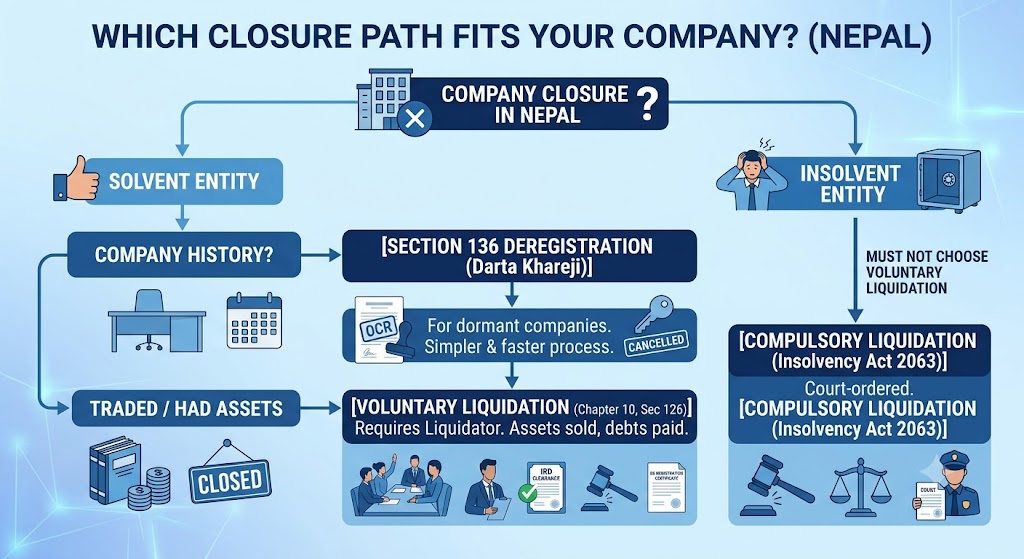
Route A: Cancellation of Registration / Deregistration (Section 136)
If your company was incorporated but never commenced business operations, or if it has been completely inactive with zero balance sheet assets and liabilities, you qualify for Darta Khareji (Cancellation of Registration) under Section 136 of the Companies Act 2063.
- Best For: Shell companies, unused tech startups, SPVs that never raised funds, or entities with zero commercial transactions.
- Average Timeline: 2 to 4 months.
- Key Requirement: An official auditor statement confirming zero economic activity and clean tax clearance.
Route B: Voluntary Liquidation (Chapter 10, Section 126)
If your company actively traded, held bank balances, owned fixed assets, or employed staff—and can comfortably pay off all outstanding liabilities within 12 months—you must execute a formal Voluntary Liquidation.
- Best For: Operating entities, profitable businesses winding up, or foreign branch offices exiting the market.
- Average Timeline: 4 to 8 months.
- Key Requirement: Appointment of a licensed Liquidator (Chartered Accountant or Advocate) and public notice in a national daily newspaper.
Route C: Compulsory Liquidation (Insolvency Act 2063)
If company liabilities exceed total asset values and the business cannot pay its debts as they mature, you cannot use voluntary mechanisms. Creditors or directors must petition the Commercial Bench of the High Court under the Insolvency Act 2063.
Closure Route Comparison
| Feature | Section 136 Deregistration | Voluntary Liquidation | Compulsory Liquidation |
| Primary Governing Law | Companies Act 2063 (Sec 136) | Companies Act 2063 (Chap 10) | Insolvency Act 2063 |
| Operational History | No business commenced / Defunct | Active trading, fully solvent | Insolvent (Liabilities Assets) |
| Liquidator Required? | No | Yes (CA or legal practitioner) | Court-appointed Administrator |
| Newspaper Notice? | Yes (published by OCR/Company) | Yes (30/35-day creditor notice) | Yes (Court directions) |
| Estimated Cost Range | NPR 50,000 – 120,000 | NPR 150,000 – 550,000+ | High (Court & insolvency fees) |
2. Step-by-Step Procedure for Voluntary Liquidation
Voluntary liquidation follows six sequential legal phases: passing a shareholder special resolution (75%+ vote), appointing a liquidator, notifying the OCR within 15 days, publishing a 35-day national daily newspaper notice, securing IRD tax clearance, and submitting the final liquidator report for registration cancellation.
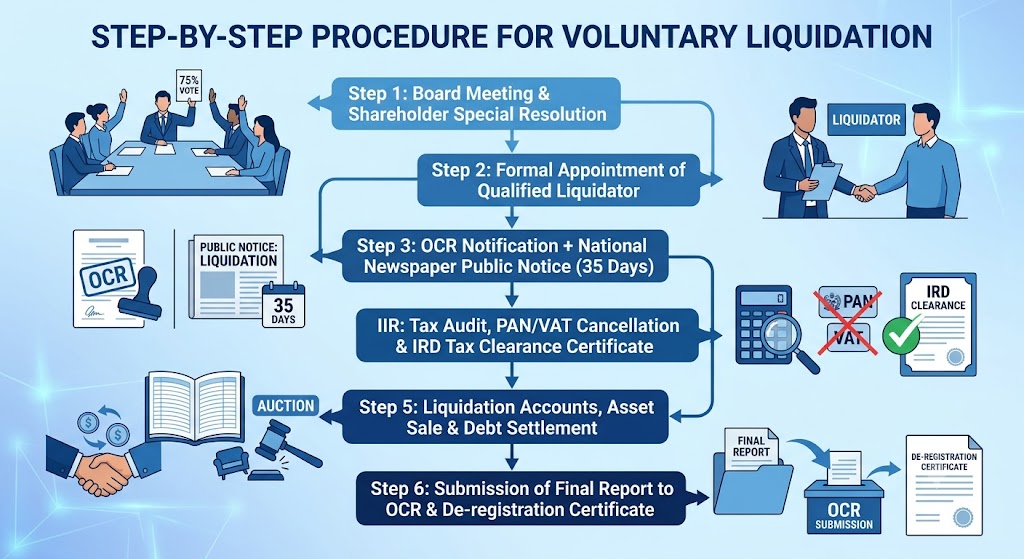
Step 1: Board Resolution and Shareholder Special Resolution
The closure process starts internally. The Board of Directors must convene a meeting to pass a resolution proposing dissolution and declaring that the company can discharge all outstanding liabilities in full.
Next, call an Extra-Ordinary General Meeting (EGM) or Annual General Meeting (AGM) to pass a Special Resolution. Under Nepalese corporate law, a special resolution requires an affirmative vote from shareholders holding at least 75% of total paid-up share capital.
Step 2: Appointment of a Liquidator
Upon passing the closure resolution, shareholders must appoint an independent, qualified Liquidator.
- Qualifications: The liquidator must be a practicing Chartered Accountant (CA) registered with ICAN or an Advocate with corporate restructuring experience.
- Powers: Once appointed, the board of directors loses management control. The liquidator takes custody of all corporate assets, operational accounts, and official registers.
Step 3: Notification to the OCR & Public Newspaper Notice
Within 15 days of passing the special resolution, the liquidator or board must file notice of the liquidation decision and liquidator appointment with the OCR.
Simultaneously, you must publish a public notice in a national daily newspaper (such as Gorkhapatra, Kantipur, or The Kathmandu Post).
- Notice Window: The notice gives creditors, contractors, employees, and suppliers a 30 to 35-day window to submit written claims and financial demands against the company.
Step 4: Tax Clearance Certificate (The IRD Bottleneck)
This is where 80% of company closures get delayed. Before the OCR will erase your company, the local Inland Revenue Office (IRO) where your company PAN/VAT is registered must conduct a thorough audit.
- File all pending monthly/quarterly VAT returns, TDS (Tax Deducted at Source) returns, and annual Income Tax returns up to the date of liquidation.
- Clear all outstanding tax principal, late filing penalties (Under Section 117 of Income Tax Act 2058), and accrued interest.
- Apply for VAT Deregistration and PAN Deactivation.
- The Tax Officer will conduct an audit, checking purchase/sales invoices (Kharid-Bikri Khata) and bank statements.
- Upon satisfaction, the IRD issues a Tax Clearance Certificate (Kar Chukta Praman Patra) explicitly approving the company's closure.
Pro Tip on IRD Audits: Do not attempt tax clearance with un-reconciled TDS or mismatched VAT ledgers. The tax office will freeze the process until every rupee matches the Integrated Tax System (ITS) portal records.
Step 5: Employee and Debt Settlement
Before remaining cash can be returned to investors, the liquidator must follow Nepal’s statutory payment priority:
- Liquidation administrative costs and liquidator fees.
- Employee terminal dues, including pending salaries, accumulated leave pay, gratuity under the Labor Act 2074, and Social Security Fund (SSF) contributions.
- Secured loans and bank debts.
- Unsecured trade creditors and government levies.
- Distribution of remaining net balance to shareholders based on shareholding proportion.
Step 6: Final Accounts, OCR Submission, and Dissolution Certificate
The liquidator prepares a Final Liquidation Audit Report detailing how assets were sold, how debts were discharged, and how funds were distributed.
Submit the following dossier to the OCR:
- Original Company Registration Certificate.
- Certified Memorandum & Articles of Association (MOA/AOA).
- EGM Minutes containing the 75% Special Resolution.
- Original copies of the national newspaper public notice.
- IRD Tax Clearance Certificate and PAN cancellation letter.
- Final Audited Liquidation Account and Liquidator’s formal report.
The Registrar reviews the dossier and publishes the final corporate strike-off. The OCR then issues the Certificate of Dissolution (Kompany Khareji Praman Patra). At this exact moment, the corporate entity ceases to exist.
3. The "Ghost Liability" Trap: Why Abandoning a Company Backfires
Abandoning an inactive company without formal closure causes annual fines under Section 81 of the Companies Act 2063 to accumulate indefinitely. Furthermore, Section 136(7) and Section 136(9) maintain director personal liability for unsettled debts, while the OCR blacklists directors from future corporate endeavors.
A common misconception among local and foreign founders is: "If I stop filing annual OCR compliance documents and leave the bank account empty, the state will close the company for me."
While Section 136(1)(b) gives the OCR authority to strike off companies that default on annual returns for three consecutive years, this is not a clean or safe exit. It is an administrative default proceeding that leaves heavy legal baggage.
1. Director Blacklisting at OCR
When the OCR involuntarily cancels a non-compliant company, the names and passport/citizenship numbers of all listed directors are tagged in the central digital system. These directors will be barred from registering new companies, acquiring shares in existing companies, or serving as directors/officers in Nepali entities.
2. Personal Liability Preservation
Under Section 136(7) of the Companies Act 2063, the cancellation of a company's registration does not extinguish the outstanding liabilities of its officers and shareholders. If unpaid tax dues, bank loans, or trade creditors remain, creditors can file claims against directors personally under Section 136(9).
3. Escalating Fines Under Section 81
Every year a company misses filing its annual AGM minutes, auditor reports, and share structure updates (Poush Manta compliance), fines compound exponentially under Section 81. By year five, administrative fines can easily exceed NPR 100,000—money that must be paid before any clear administrative status can ever be restored.
4. Documentation Checklist for Smooth Closure
A complete Nepal company closure file requires seven primary items: Board/EGM minutes, Liquidator appointment acceptance, national daily newspaper clippings, IRD Tax Clearance Certificate, audit reports up to closure date, employee clearance receipts, and original OCR corporate certificates.
Before starting the digital portal filing at the OCR system, prepare the following documents:
- [ ] Board Meeting Minutes: Signed resolution approving intent to liquidate.
- [ ] EGM Special Resolution: 75% shareholder approval of closure and liquidator appointment.
- [ ] Liquidator Consent Letter: Written acceptance from a licensed CA/Advocate.
- [ ] Newspaper Clippings: Full original page of the national daily newspaper showing the 30/35-day creditor notice.
- [ ] Tax Clearance File: Final year tax return receipts, VAT deregistration letter, and IRD Tax Clearance Certificate.
- [ ] Employee Clearance Proofs: Signed payroll receipts, gratuity settlement forms, and SSF exit clearance.
- [ ] Bank Closure Letter: Official letter from your commercial bank confirming account closure and zero balance.
- [ ] Original Company Documents: Original OCR Company Registration Certificate, MOA, AOA, and share certificates.
Frequently Asked Questions (FAQs)
How long does it actually take to close a company in Nepal?
For a non-traded company using Section 136 deregistration, expect 2 to 4 months. For an active company undergoing full voluntary liquidation under Chapter 10, the process typically takes 4 to 8 months. The tax audit at the Inland Revenue Office accounts for most of this time.
Can a foreign-owned company (FDI entity) close in Nepal?
Yes. However, foreign-invested Pvt. Ltd. entities require additional clearances from the Department of Industry (DOI) or Investment Board Nepal (IBN) and Nepal Rastra Bank (NRB) to repatriate remaining capital back to the home country after all taxes and local obligations are settled.
What is the total cost of winding up a Pvt. Ltd. company?
Total costs range between NPR 150,000 and NPR 550,000 for standard small-to-medium businesses. This includes liquidator professional fees (NPR 50,000–200,000), auditor fees (NPR 40,000–150,000), newspaper publication charges (NPR 5,000–15,000), legal documentation fees, and official OCR filing charges.
What happens if shareholders disagree on closing the company?
A voluntary liquidation requires a 75% majority vote of shareholders present at the General Meeting. If minority shareholders holding under 25% oppose the closure, the majority can still pass the resolution. If shareholders holding more than 25% object, voluntary closure cannot proceed, and disputing parties must resolve internal conflicts or petition the High Court under Section 136 or Section 138 for protection.